
A solid SEO strategy template is more than a to-do list. It's the architectural blueprint that ties your search engine performance directly to business revenue, transforming SEO from a guessing game into a predictable growth channel. This guide provides a revenue-first template designed for one purpose: measurable results.
Your Blueprint for Predictable Organic Growth
I've seen countless SEO plans fail. Why? They chase vanity metrics like traffic and rankings while ignoring what actually drives business: revenue. A generic checklist won't clarify why you're writing a blog post or how a technical tweak will generate more qualified leads. It's time for a more strategic approach.
The power of an effective template is that it compels you to answer the critical questions upfront:
- Who is our ideal customer, and what specific problems are they trying to solve?
- Which keywords indicate a user is ready to buy versus merely researching?
- How does our content guide a prospect from initial awareness to becoming a paying customer?
- What technical issues are preventing Google from seeing and ranking our most valuable content?
Answering these questions elevates SEO from a reactive marketing task to a core business driver. For a B2B SaaS company like HubSpot, this means creating content targeting keywords like "best crm for small business," which directly addresses the needs of their target audience. We explore this approach in our guide to SEO for SaaS companies. For an e-commerce brand like Allbirds, it means optimizing product pages for "comfortable walking shoes" to capture high-intent buyers.
From Analysis to Actionable Growth
A winning strategy isn’t magic; it’s a methodical process. It starts with a deep analysis of data, which informs a clear plan, and culminates in measurable growth.
The infographic below illustrates this exact workflow for building an SEO plan that is laser-focused on revenue.
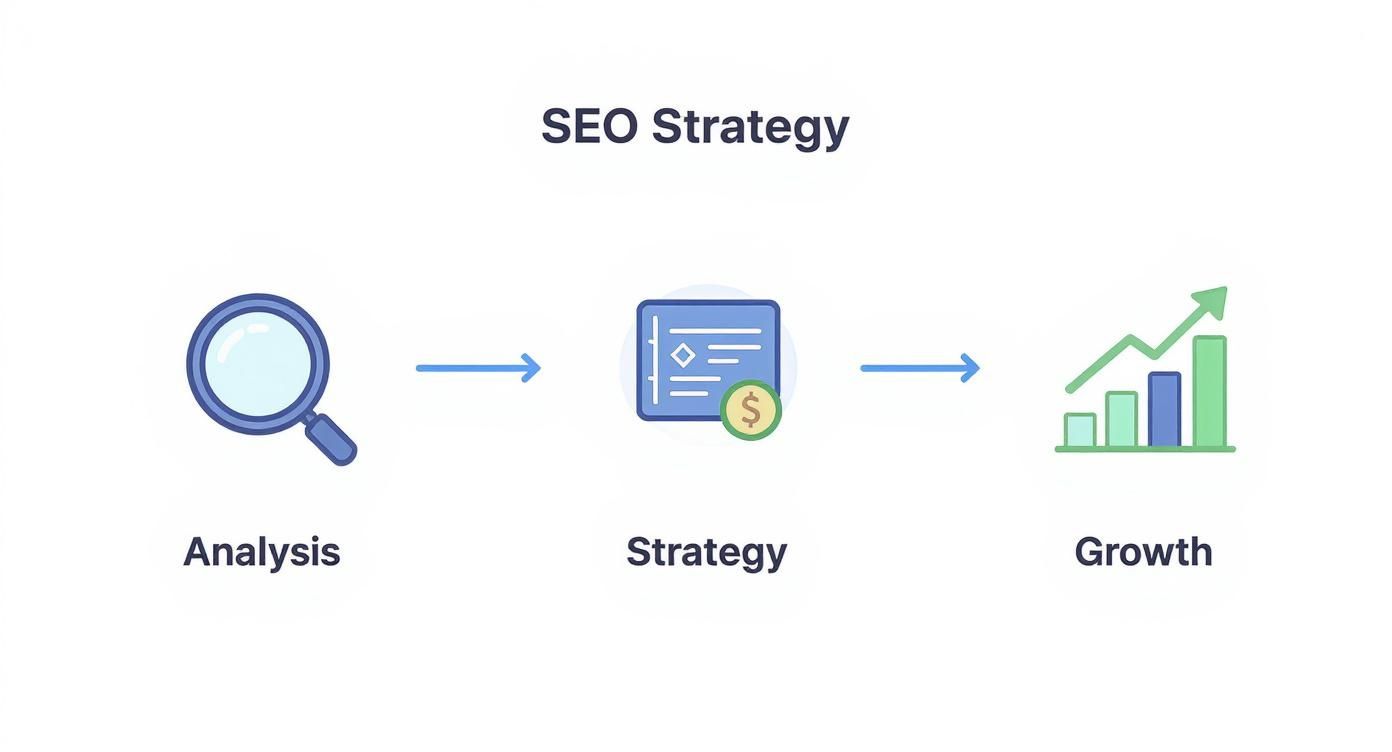
This workflow underscores a critical point: sustainable results stem from rigorous analysis and strategic planning, not from random acts of content creation.
Let's briefly outline the core pillars of our template. Each component is designed to build on the previous one, creating a cohesive and actionable strategy.
Core Components of a Revenue-Focused SEO Template
| Template Component | Primary Goal | Key Business Impact |
|---|---|---|
| Business & SEO Goals | Define clear, measurable objectives | Aligns SEO efforts directly with company revenue targets |
| Audience & Keywords | Understand user intent and map relevant terms | Attracts high-quality traffic with a higher chance to convert |
| Technical SEO | Ensure the site is crawlable and indexable | Improves user experience and search engine visibility |
| Content Strategy | Create content that solves user problems | Builds authority, trust, and drives organic traffic |
| Link Building | Acquire authoritative, relevant backlinks | Boosts domain authority and referral traffic |
| Measurement | Track progress against defined KPIs | Provides data to prove ROI and refine the strategy |
As illustrated, every component is explicitly designed to connect back to a tangible business outcome.
Of course, the search landscape is constantly evolving. For years, securing the #1 ranking was paramount, as top results captured the majority of clicks. However, this has changed. A recent Backlinko study revealed that a staggering 58.5% of Google searches now end without a click to any website. This phenomenon is driven by AI Overviews and other SERP features that provide answers directly on the results page.
This shift confirms why a modern SEO strategy must extend beyond chasing clicks. It must focus on overall brand visibility and delivering value, even if a user never visits your site.
A powerful SEO strategy doesn't just chase rankings; it builds a system. It ensures that every keyword targeted, every backlink earned, and every piece of content published serves a single, unified purpose: driving tangible business results.
Our template is built on this philosophy. Each section, from defining your audience to tracking performance, is interconnected, creating a cohesive plan that fuels long-term, predictable growth.
Building Your Technical SEO Foundation
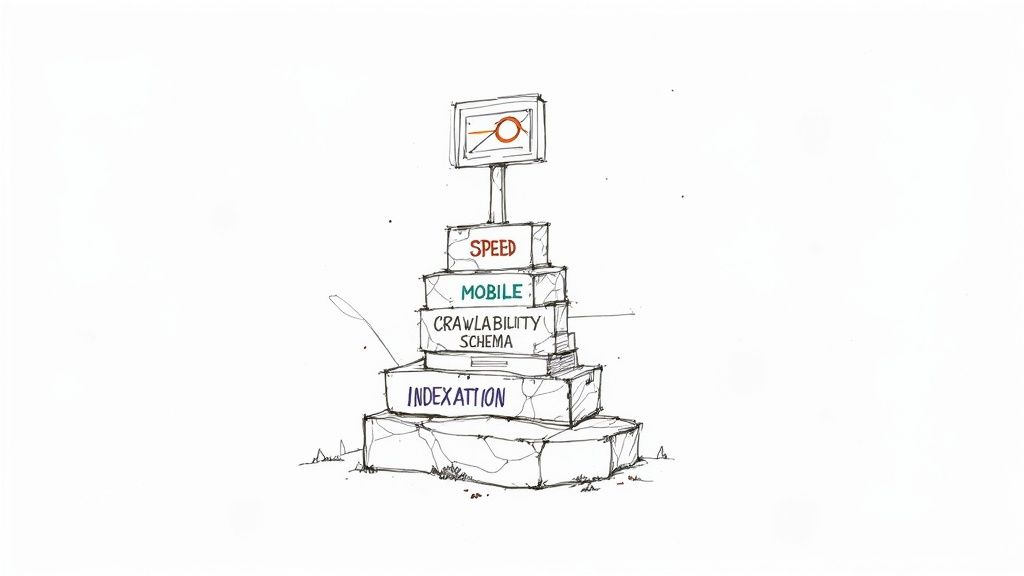
Think of technical SEO as the foundation of a house. You can invest in beautiful interior design, but if the foundation is compromised, the entire structure is at risk. The same principle applies to your website. Without a sound technical base, even the most brilliant content strategy will underperform.
This section of your SEO strategy template isn't about short-term tactics; it’s about ensuring search engines can efficiently find, crawl, understand, and index your website. Get this right, and you amplify the success of all other strategic efforts. Get it wrong, and you might as well be invisible to Google.
I see this frequently, especially with e-commerce sites. One client I worked with doubled their organic traffic in just six months—not by producing more content, but by resolving critical indexation errors. Key product pages were inadvertently blocked from Google, and implementing proper schema markup helped search engines finally comprehend their product details. That fix alone had a massive impact.
Auditing Your Site's Core Vitals
Your first action should be a comprehensive site audit. This is not a one-time task; schedule it regularly within your template. The goal is to identify and resolve issues that harm both user experience and search engine performance.
When conducting an audit, focus on these critical areas:
- Crawlability and Indexability: Can search engine bots access your important pages? Check your
robots.txtfile for unintentional blocks and ensure you are using meta tags correctly to guide indexing. - Site Speed: A slow website is a known ranking-killer. Use tools like Google PageSpeed Insights to diagnose speed issues, whether from oversized images or inefficient code.
- Mobile Experience: With the majority of searches occurring on mobile devices, a poor mobile experience is no longer acceptable. Your site must be responsive and user-friendly on smaller screens.
- Site Architecture: Is your site structured logically? A clean, intuitive architecture helps both users and search engines find content. A disorganized structure often leads to broken internal links and "orphan pages" that Google cannot discover.
Technical SEO isn’t just a checklist of fixes. It's an ongoing commitment to providing a seamless, fast, and accessible experience for both search engines and human visitors. Neglecting it is like trying to win a race with the emergency brake on.
The technical bar is always rising, yet many websites still struggle with the basics. It's surprising, but research shows that over 66% of backlinks are broken, and more than 23% of sites use no structured data at all. Even more striking, 7.4% of pages ranking in the top 10 are missing a title tag. You can discover more insights about these common SEO pitfalls and see why maintaining your site's technical health is so crucial.
From Audit Findings to Actionable Priorities
After your audit generates a list of issues, you must prioritize them. Not all technical problems carry the same weight. A sitewide indexing issue is a critical emergency, while a few images missing alt text can be addressed later.
Use your template to categorize fixes by impact and effort. For example, correcting an improper canonical tag on a high-value product page is a high-impact, low-effort task that should be prioritized immediately.
Consider this example from Google's own documentation on how a simple line of code—the robots meta tag—can instruct crawlers on how to handle a page.
This screenshot displays specific directives like noindex or nofollow, which are powerful instructions for search engines. If used incorrectly, you could accidentally de-index your entire site. This is precisely why a detailed technical checklist in your SEO template is non-negotiable.
Mapping Keywords to the Customer Journey
Effective SEO isn't just about driving more clicks; it's about attracting the right clicks at the right time. A large spreadsheet of keywords is merely raw data. The strategy emerges when you map those keywords to the distinct stages of your customer's journey.
This is where we move beyond basic keyword research to understanding search intent. You must empathize with your customer and understand the why behind their search—what problem are they trying to solve? What questions are they asking Google? Every search query reveals where someone is in the buying process.
Your SEO strategy template must include a section for this mapping. It transforms a random collection of blog posts into a cohesive system that guides prospects from "I have a problem" to "I need your solution."
From Problem-Aware to Solution-Ready
Let's make this practical. Imagine a B2B SaaS company that sells project management software. Their ideal customers don't just wake up and search for the brand name. The journey is longer and typically starts with a persistent problem.
Here’s a real-world example of how to map keywords across the funnel:
-
Top of Funnel (Problem-Aware): The customer is experiencing pain but hasn't yet identified a solution. Their searches are broad and informational. For our SaaS example, this includes queries like "how to manage team workload" or "remote team collaboration challenges." The content here should educate and build trust, not hard-sell.
-
Middle of Funnel (Solution-Aware): Now, they know that tools like project management software exist. They are in comparison mode, using keywords such as "best project management tools for small business" or "[Competitor A] vs [Competitor B]." Your content must help them evaluate their options effectively.
-
Bottom of Funnel (Brand-Aware): At this stage, they are close to a decision and are investigating specific providers. Their searches become highly specific, such as "[Your Brand] pricing," "[Your Brand] reviews," or "how to implement [Your Brand]." This is where you provide compelling case studies, demos, and clear feature pages.
Mapping keywords to the customer journey transforms your content from a library of disconnected articles into a guided pathway. Each piece of content serves a specific purpose, answering the right question at the right time to build trust and move the user forward.
By categorizing your keywords in this way, you can develop a content plan that meets users exactly where they are. This strategic alignment is the key differentiator between SEO that merely drives traffic and SEO that drives revenue.
Uncovering Intent with Modern Tools
So, how do you find these keywords and determine their intent? Fortunately, you don't have to guess. Modern SEO tools provide the data needed to understand user motivations.
When filling out this section of your template, focus on these actionable steps:
- Analyze the SERPs: Manually review the search results for your target keywords. Does Google display a "People Also Ask" box, video results, or shopping ads? These SERP features are direct clues from Google about what searchers want.
- Look for Keyword Modifiers: Pay attention to words that reveal intent. Modifiers like "how," "what," and "why" indicate top-of-funnel informational searches. Conversely, terms like "best," "review," "alternative," and "comparison" signal middle-of-funnel evaluation.
- Utilize SEO Tools: Platforms like Ahrefs or Semrush have built-in intent filters (informational, navigational, commercial, transactional). This feature automates much of the analysis, providing a strong starting point for your content map.
Once your keywords are mapped, the next step is to assign them to specific content formats. A "problem-aware" keyword like "how to improve team productivity" is ideal for a comprehensive blog post. A "solution-aware" keyword like "Asana vs Trello" is perfect for a detailed comparison guide.
For "brand-aware" searches, ensure your pricing and case study pages are fully optimized. The role of branded search in signaling authority is a critical topic; you can explore whether branded search volume is a ranking signal in our detailed article. This level of detailed mapping provides a clear and powerful content production roadmap.
Creating a Content Plan That Actually Converts
A brilliant keyword map is just a starting point. Without high-quality content to bring it to life, it's like having a blueprint with no builders. This is where your SEO strategy template gets its engine: a content plan designed to attract, engage, and ultimately convert your ideal customers. We are not just filling a calendar; we are architecting an ecosystem where every piece of content has a specific job.
First, let's abandon the notion that "content" is limited to blog posts. A high-impact plan utilizes a strategic mix of formats to engage users at different stages of their journey.
Think of it as a toolkit; you need the right tool for the right job. An effective content plan might include:
- In-depth Guides: Ideal for targeting broad, informational keywords and establishing your authority on a topic.
- Video Tutorials: The best format for visually explaining a complex process or demonstrating a product feature.
- Product & Service Pages: These are your "money pages," laser-focused on commercial and transactional keywords.
- Original Research & Data Studies: Nothing builds backlinks and establishes thought leadership faster.
- Comparison Articles: Essential for capturing users who are evaluating their options and are close to a purchase decision.
This diverse approach ensures you meet users where they are, guiding them from casual browsers to confident buyers.
Structuring Content with Topic Clusters
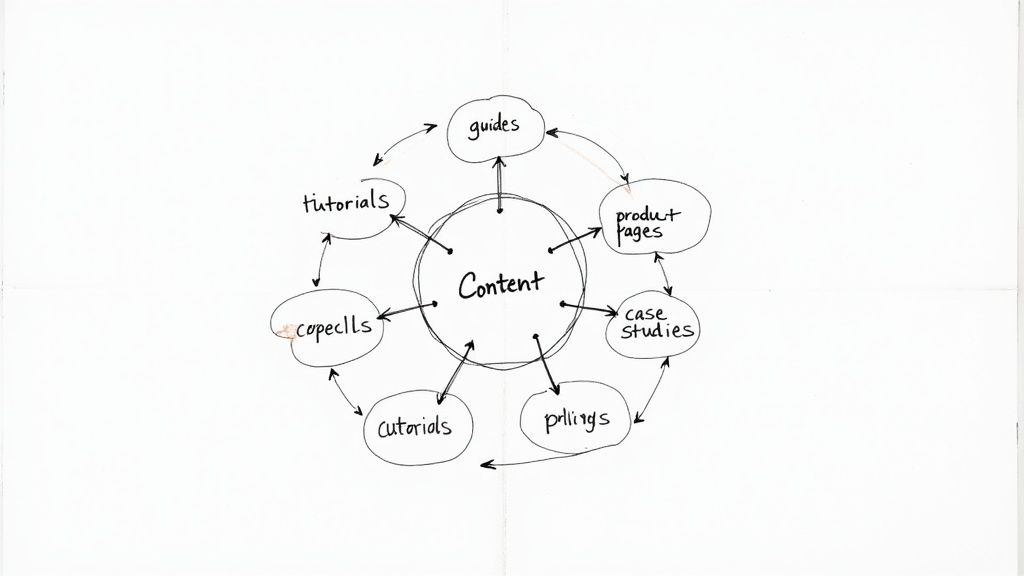
One of the most effective methods for building authority and organizing a content plan is the topic cluster model. This powerful framework involves creating one comprehensive central "pillar" page and surrounding it with several supporting "cluster" pages.
Let’s use the real-world example of HubSpot, who mastered this model for CRM-related topics.
-
Pillar Page: They created a massive, definitive guide targeting the broad keyword "CRM." This page serves as the ultimate resource, covering the topic from A to Z—what it is, its benefits, essential features, and implementation steps.
-
Cluster Content: From there, they developed shorter, more focused articles targeting related long-tail keywords, such as "how to build a CRM database," "best free CRM software," or "CRM implementation plan."
Each cluster article links back to the main pillar page. This creates a powerful internal linking structure that signals to Google, "We are the definitive experts on this topic." As a result, the entire cluster of pages begins to rank higher.
Content without a clear conversion path is just a hobby. A revenue-focused content plan ensures every article, guide, and video not only answers a user's question but also gently guides them toward becoming a customer.
This model transforms your blog from a random collection of articles into a structured library that systematically builds topical authority. It is an essential component of any serious SEO strategy template.
From Idea to Execution with Content Briefs
In my experience, exceptional content is never accidental. It originates from a detailed content brief—a roadmap that aligns your writer, SEO specialist, and subject matter expert. A solid brief acts as an insurance policy against wasted effort and ensures the final asset achieves its strategic objectives.
Your template must include a section for developing these briefs. At a minimum, each brief should specify:
- Primary Target Keyword: The main search term this piece is intended to rank for.
- Secondary Keywords: Related terms to incorporate for semantic depth.
- Target Audience & Funnel Stage: Who are we addressing, and where are they in the buying cycle?
- Key Talking Points & Outline: A clear structure for the writer to follow.
- Internal Linking Opportunities: Specific pages on our own site that this piece should link to.
This level of detail ensures every piece of content is created with purpose and is optimized from the outset.
Measuring What Matters Most
Finally, your content plan is incomplete without defining what success looks like. Increased traffic is a positive sign, but it doesn't pay the bills. To truly understand what's working, you must connect your content to tangible business outcomes.
You need to track the engagement and conversion metrics that truly matter:
- Conversion Rate: What percentage of organic visitors to a page completes a desired action (e.g., signing up for a demo, making a purchase)?
- Leads Generated: How many qualified leads did a specific piece of content produce?
- Assisted Conversions: Which articles were part of a user's journey to conversion, even if they weren't the final touchpoint?
Monitoring these KPIs reveals which content is actually impacting the bottom line. This is the core of a revenue-driven SEO approach, allowing you to double down on what works and re-evaluate what doesn’t.
Developing a Sustainable Link Building Strategy
Backlinks remain one of the strongest signals of authority for search engines. However, the days of buying cheap links or spamming directories are long gone. A modern SEO strategy template must be built around a sustainable, relationship-driven approach that earns high-quality, relevant backlinks. This isn't about gaming the system; it's about creating something so genuinely valuable that it naturally attracts authoritative mentions.
The mindset has shifted from "How can I get a link?" to "How can I create something so good that people want to link to it?"
The cornerstone of this approach is creating linkable assets—high-value pieces of content or tools that act as magnets for backlinks.
Creating Your Linkable Assets
A linkable asset is your strategic advantage. It provides other websites with a compelling reason to reference you. Your strategy template should have a dedicated section for brainstorming and planning these assets.
Here are a few types of linkable assets that consistently produce results:
- Original Research or Data Studies: Conduct a survey in your industry and publish the findings. This positions you as an expert and creates a unique data source that journalists and bloggers will cite. For example, BuzzSumo regularly publishes research on content trends, earning thousands of backlinks.
- Free Tools or Calculators: Develop a simple, useful tool that solves a common problem for your audience. A SaaS company could create a free ROI calculator for its niche, like HubSpot’s Website Grader tool.
- Definitive Guides: Aim to create the single best, most comprehensive resource on a specific topic. If your guide is the most thorough available, it will become the go-to reference.
- Compelling Infographics: Visualize complex data or processes in an easy-to-digest format. A well-designed infographic can be shared and embedded across numerous articles.
By focusing your energy here, you are not just chasing individual links; you are building a renewable resource for acquiring high-quality links that build true authority.
Activating Your Assets with Smart Outreach
Once you've created a valuable asset, you can't just wait for people to find it. You must proactively inform the right people of its existence. This is where smart digital PR and targeted outreach come into play. This is not about sending generic email blasts; it’s about building genuine connections.
Your outreach strategy should include these key components:
- Prospecting: Identify websites, journalists, and bloggers who have previously written about similar topics or linked to related resources. Tools like Ahrefs or Semrush are invaluable for this.
- Personalization: Craft a personalized pitch that clearly explains why your asset would be valuable to their specific audience. Reference their previous work to demonstrate you've done your research.
- Capitalizing on Mentions: Set up alerts for your brand name. When another site mentions you without linking, a polite and friendly outreach email can often convert that mention into a valuable backlink. This is one of the easiest wins in link building.
Link building is no longer a volume game; it's a value game. The most powerful backlink profiles are built not by aggressive tactics, but by consistently creating assets so useful and authoritative that others can't help but link to them.
A Local Service Business Case Study
Let's illustrate this with a real-world example. I once worked with a local HVAC company that was being outranked by larger competitors. Instead of pursuing low-quality links, we focused on community partnerships.
First, they created a "Seasonal Home Maintenance Checklist" as a simple, downloadable PDF. It was genuinely useful. Then, they reached out to local real estate agents, property managers, and neighborhood blogs, offering the checklist as a free resource for their clients and readers. This single tactic earned them dozens of highly relevant, local backlinks.
They also sponsored a local youth sports team, which resulted in a link from the league’s official website and mentions in local news articles covering the team—all powerful signals that solidified their authority in their service area. Within a year, their backlink profile was strong enough to help them dominate local search for their most profitable keywords, proving that a creative, value-first strategy always wins.
Measuring What Actually Matters: Tracking Your SEO Success
An SEO strategy is just a document until you can prove its impact. After all the technical audits, content creation, and link-building outreach, you need a clear answer to the question: "Is this generating more revenue?" This is where your SEO strategy template becomes a dynamic performance tracker, focusing on the metrics that truly move the needle.
It's easy to get distracted by vanity metrics. A large spike in organic traffic looks great in a presentation, but if those visitors aren't converting into customers, it's a hollow victory. The goal of tracking is to draw a direct line from your SEO efforts to your business objectives.
Look Past the Obvious Metrics
Stop obsessing over a long list of keyword rankings. Instead, focus on the movement of your most valuable, bottom-of-the-funnel keywords—the ones people search for right before making a purchase. When you see those terms climb from page three to the top of page one, you are looking at a powerful leading indicator of future revenue.
The same principle applies to traffic. Instead of just monitoring the total number of organic visitors, I always prioritize the organic conversion rate. Are visitors from Google actually signing up for a demo, buying a product, or requesting a quote? That single metric tells you if you're attracting the right audience.
The goal isn't just to be found; it's to be found by the right people at the right moment. Shifting your focus from broad traffic metrics to specific conversion KPIs is the fastest way to prove the real business value of your SEO efforts.
You don't need an expensive, complex tool for this. A simple dashboard created with Google Analytics 4 and Google Search Console is more than sufficient to start. Focus on a handful of core metrics that tell a clear story, rather than overwhelming stakeholders with data.
Choosing KPIs for Different Business Models
The metrics that matter most depend entirely on your business model. What a SaaS company needs to track is fundamentally different from what a local plumber or an e-commerce brand should monitor. Your strategy template must reflect this reality.
To clarify, here is a breakdown of the KPIs I prioritize for different business types.
Choosing KPIs for Different Business Models
| Metric | B2B SaaS | eCommerce | Local Service Business |
|---|---|---|---|
| Primary Conversion | Demo Requests, Trial Sign-ups | Completed Purchases | Phone Calls, Form Fills |
| Key Traffic Metric | Organic MQLs (Marketing Qualified Leads) | Organic Revenue | Clicks to Call, Driving Directions |
| Engagement Signal | Asset Downloads (e.g., whitepapers) | Add to Cart Rate | Appointment Bookings |
| Long-Term KPI | Customer Lifetime Value (LTV) from Organic | Average Order Value (AOV) | Lead-to-Customer Rate |
As you can see, the goals are completely different, so the measurement must be as well.
For my B2B SaaS clients, connecting SEO to long-term value is paramount. It’s not just about generating a lead; it’s about understanding the downstream impact of that organic lead on the business. In fact, properly calculating LTV for SaaS is a game-changer for justifying larger investments in high-quality content and link-building campaigns that attract the most valuable customers.
Ultimately, this measurement framework achieves two critical objectives. First, it provides the real-world data needed to make smarter decisions about where to allocate your time and budget. Second, it delivers undeniable proof of ROI, which gets leadership excited and demonstrates the power of a well-executed SEO strategy.
Answering Your SEO Strategy Questions
Even with a detailed template, questions will arise as you begin implementation. Getting these questions answered is crucial for maintaining momentum and turning a plan into tangible results. Let's address some of the most common ones.
How Often Should I Revisit My SEO Strategy?
Your SEO strategy should not be a static document. Think of it as a living guide for your search marketing efforts.
As a general rule, I recommend a comprehensive review every 6 to 12 months. However, you cannot let it sit idle for that long. Schedule quarterly check-ins to review performance against your goals and make necessary tactical adjustments.
Certain components, such as your keyword research and content calendar, may require more frequent updates, especially in a dynamic industry or when a new competitor emerges. This practice keeps your strategy relevant and aligned with current market conditions.
Is This Template a Good Fit for a Brand New Website?
Yes, absolutely. For a new website, a structured template like this is even more critical. It forces you to establish a solid foundation from the start, covering all technical, content, and authority-building fundamentals.
For a new site, your initial efforts will focus heavily on foundational keyword research and perfecting technical SEO. The link-building component will naturally follow as you begin publishing high-quality content that gives other sites a reason to link to you. For more content ideas, feel free to explore our SEO blog.
The biggest mistake I see is when people treat a template as a one-time, fill-in-the-blanks exercise. It's a framework, not a magic bullet. To get sustained results, you have to actively use and adapt it.
Another common mistake is pursuing traffic goals that are not tied to business objectives, which leads to an influx of visitors who do not convert. Finally, do not neglect the tracking section—if you aren't measuring your efforts, you cannot prove ROI, and you cannot learn from what is working (or what isn't).
Ready to build an SEO plan that directly fuels your growth? SEO by Tim specializes in creating revenue-focused strategies where every action is tied to your bottom line. Book a free 30-minute discovery call and let's map out a path to predictable, compounding growth.
Article created using Outrank




 SEO by Tim