
Any effective SEO strategy starts with a clear-eyed look at where you stand right now. For a service-based business, this isn’t just a technical exercise; it’s a strategic analysis of what’s working, what’s broken, and where your biggest opportunities for growth are hiding.
Let’s be direct: if a potential client can’t find you on Google the moment they need your expertise, you might as well be invisible. This guide provides a hands-on framework to turn your website from a digital brochure into a consistent, reliable lead-generation machine.
Your SEO Blueprint for Real Growth
For a service business, a strong online presence is non-negotiable. The data tells a clear story: around 53% of all website traffic flows from organic search, making it the single largest source for new visitors. If you aren’t showing up, you’re essentially handing over half of your potential market to the competition.
The battle for attention is won or lost on the first page of Google. Since nearly 75% of users never click to the second page, high rankings are everything. This is where a focused SEO approach for service businesses really shines. It’s not about casting a wide net; it’s about connecting with local customers who are actively looking for the solutions you provide.
The Game-Changing Power of Local Search
Local search is where service providers win. An incredible 46% of all Google searches are from people looking for something in their immediate area. Think “plumber near me” or “accountant in Brooklyn.”
Even better? A whopping 88% of those local searches on a smartphone lead to a call or a visit within a week. That’s not just traffic; those are high-intent customers ready to make a decision. Your local presence directly taps into this stream of ready-to-buy clients.
On the flip side, being invisible online has a very real cost. If a customer can’t find you online, 62% say they’re likely to just write you off completely. A weak search presence isn’t just a missed opportunity—it’s actively sending clients to your more visible competitors.
For a service provider, SEO is about much more than traffic. It’s about building trust and being accessible. Your Google ranking is often a client’s first impression, and it can determine if you’re even in the running.
Before you jump into new tactics, you need to know your starting point. A thorough SEO audit gives you that clarity, helping you spot foundational issues, identify quick wins, and create a plan that’s actually based on data, not guesswork. This initial audit is the bedrock of any successful revenue-driven SEO strategy.
By checking your site’s technical health, content gaps, and local search footprint, you build a solid blueprint for what comes next. It’s not just about climbing rankings; it’s about creating a predictable system to attract and convert the right kind of clients.
To get started, I’ve put together a checklist that hits the most critical areas for a service-based business. Think of this as your diagnostic tool—a way to quickly find the issues that are holding you back.
Service Business SEO Audit Checklist
| Audit Area | Key Checkpoint | Why It Matters for Services |
|---|---|---|
| Technical SEO | Is the website mobile-friendly and fast? | Most local searches happen on phones. A slow site frustrates users and hurts rankings. |
| On-Page SEO | Do service pages have unique, location-specific titles & descriptions? | Clearly tells Google and customers what you do and where you do it, boosting local relevance. |
| Local SEO | Is the Google Business Profile complete, accurate, and active? | This is your digital storefront. It’s often the first thing a local customer sees. |
| Content | Does the site have content that answers common client questions? | Builds authority and trust, attracting clients early in their decision-making process. |
| Backlinks | Does the site have links from reputable local sources (e.g., Chamber of Commerce)? | Local links are a massive trust signal to Google, validating your community presence. |
This checklist isn’t exhaustive, but it covers the core pillars. Working through these points will give you a clear, prioritized to-do list that can make a real impact on your lead flow.
Designing a Website That Actually Attracts Clients
Let’s be blunt: your website’s structure is arguably the most critical piece of your entire SEO puzzle. I’ve seen countless businesses with great services fail online because their site was a chaotic mess. If potential clients can’t figure out what you do and where you do it within seconds, they’re gone. It’s that simple.
A well-organized site does the heavy lifting for you. It guides both clients and search engines, clearly communicating what you offer, where you operate, and why you’re the best choice. We need to move away from just having a random collection of pages and start thinking like an architect.
The most effective way to do this for service businesses is the hub-and-spoke model, often called topic clusters. This isn’t just jargon; it’s a proven framework for building authority.
Building Real Authority with Hub and Spoke
Imagine your core services as the center of a wheel. These are your ‘hub’ pages, and they need to be strong. These pages should target the broad, valuable keywords that define your entire service category.
Here’s what this looks like in practice:
- For a CPA: A hub page might target “Small Business Accounting Services.”
- For a plumber: A crucial hub could be “Emergency Plumbing Repair.”
- For a marketing agency: A foundational hub would be built around “Content Marketing Strategy.”
These pages are your pillars. They give a solid overview of a service and then link out to more specific, detailed content—the ‘spokes.’
The spokes are where you prove your expertise. These are your blog posts, case studies, and city-specific pages that tackle niche subtopics. They answer the specific questions your clients have and target valuable long-tail keywords. For example, a roofer’s hub page for “Roof Repair” would link out to spokes like “How to Spot Hail Damage on Shingles” and “Leaky Skylight Repair Services in Dallas.” This structure is a powerful signal to Google that you’re an authority on the entire topic. If you’re looking for more ideas on what kind of content works for these supporting pages, we’re always breaking down new strategies on our SEO blog.
This is a visual breakdown of all the moving parts that go into a proper topic cluster audit.
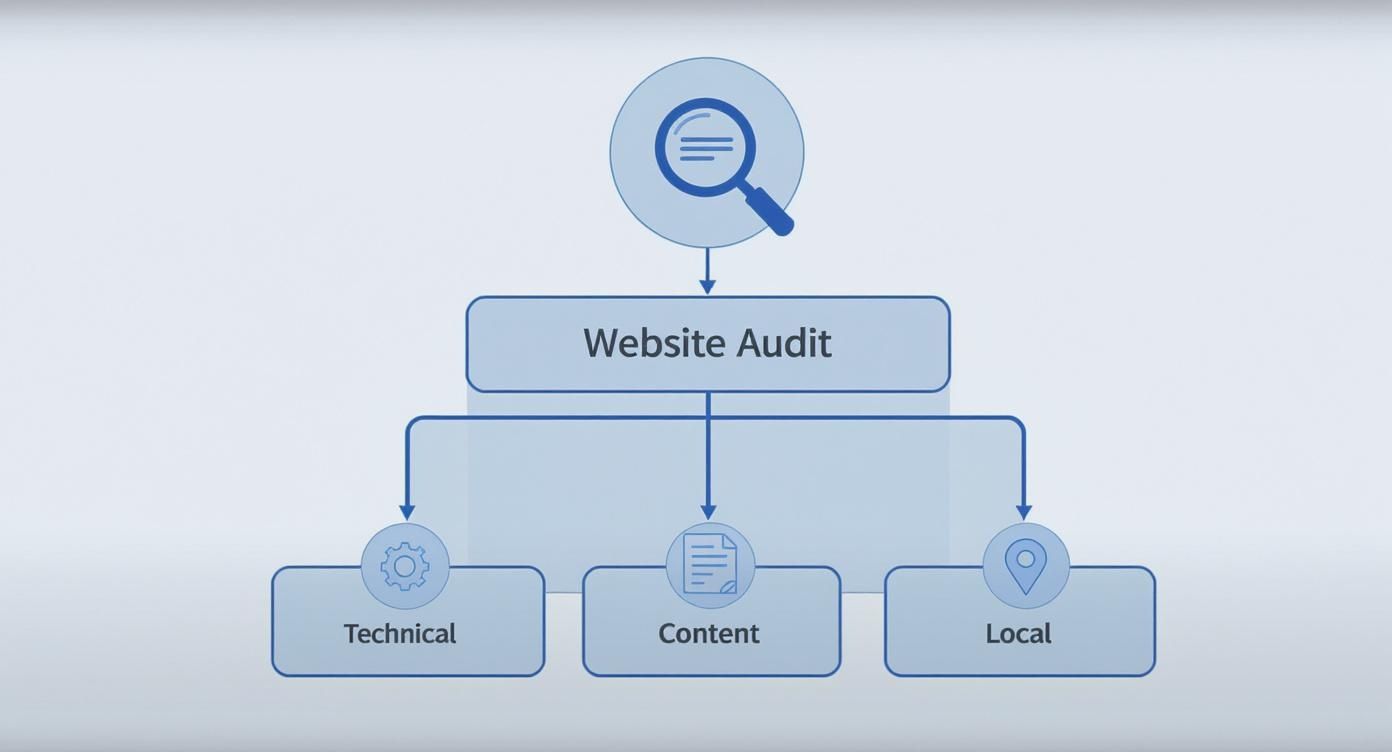
As you can see, a real audit has to look at everything—technical SEO, content quality, and local signals—to get the full picture.
Mapping Keywords to the Right Pages
One of the most common mistakes I see is trying to cram dozens of keywords onto a single page. It just doesn’t work. Great SEO is about matching what a person is searching for (their intent) with the perfect piece of content. The hub-and-spoke model forces you to do this correctly.
Let’s take a landscaping company as a practical example. Here’s how they could map their keywords and pages:
| Page Type | Target Keyword Intent | Example Keyword | Example Page Title |
|---|---|---|---|
| Hub Page | Broad & Transactional: Someone knows they need help but is still exploring their options. | “lawn care services” | Comprehensive Lawn Care Services in Nashville |
| Spoke Page (Local) | Specific & Transactional: A user is ready to hire for a specific service in their town. | “fertilization services Brentwood” | Professional Fertilization Services in Brentwood, TN |
| Spoke Page (Blog) | Informational: Someone has a problem and is searching for a DIY solution or expert advice. | “how to revive a brown lawn” | 5 Expert Steps to Revive a Brown, Patchy Lawn |
This setup is smart. When someone types in a general term, they find your main service page. When they’re trying to solve a problem themselves, they find your helpful blog post, which builds trust and positions you as the expert they’ll call when they give up. This strategic mapping is how you attract qualified leads at every single stage of their journey.
Key Takeaway: A well-structured website isn’t just for search engines; it’s for your future clients. Organizing your content into logical hubs and spokes clarifies your expertise and makes it incredibly easy for the right people to find you, trust you, and hire you.
Dominating Local Search Results
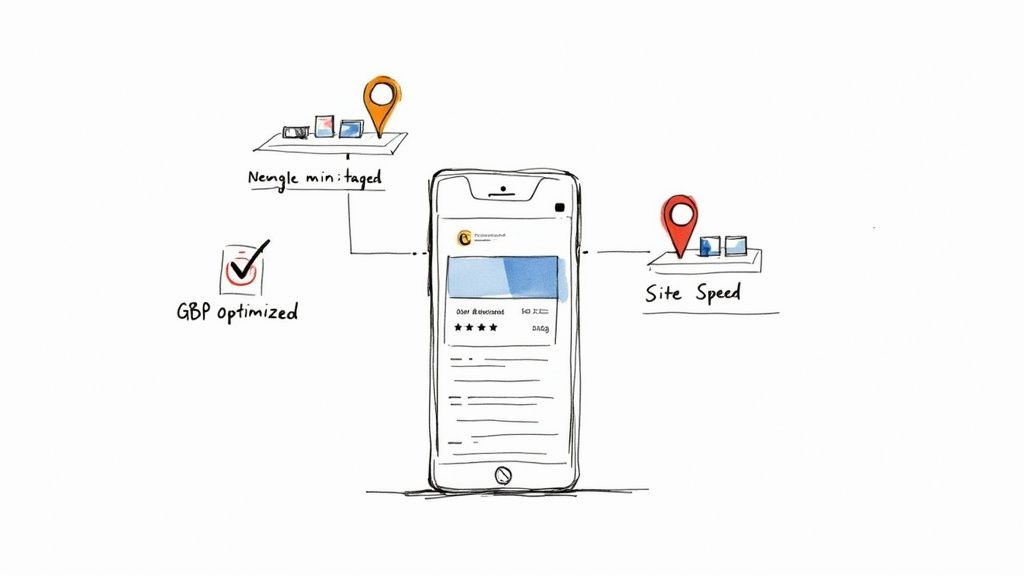
If you run a service business with a specific geographic footprint, local SEO isn’t just one piece of the puzzle—it’s the entire game. When a homeowner’s pipe bursts, they don’t search for “plumbers.” They search for “plumbers near me.”
This is where the battle for local clients is won or lost. Your goal is to be hyper-visible at that exact moment of need. Forget about ranking nationally for broad terms; this is about owning the search results for your city, your neighborhood, and even your street.
Master Your Google Business Profile
Think of your Google Business Profile (GBP) as your digital storefront. For many potential customers, it’s the very first interaction they’ll have with your brand, often before they even click through to your website. Letting it sit there collecting dust is like locking the front door of your shop.
A complete and active profile is non-negotiable. This goes way beyond just listing your name, address, and phone number.
- Client-Focused Descriptions: Don’t just list what you do. Talk about who you help and what problems you solve. A roofer shouldn’t just say “roofing services.” They should write, “We specialize in emergency roof repair for homeowners in the Springfield area, providing fast, reliable solutions to stop leaks and prevent further damage.” See the difference?
- Detailed Service Menus: Dig into the ‘Services’ feature. List every single thing you offer with a clear description and, if it makes sense, pricing. This is how Google can match you to super-specific searches like “gutter cleaning services” or “HVAC tune-up.”
- Geo-Tagged Photos: Don’t be shy. Regularly upload high-quality photos of your team on the job, finished projects, and your branded vehicles. Pro tip: make sure the location data (geo-tags) is enabled on your phone’s camera before you upload. This gives Google powerful, visual proof that you actually operate where you say you do.
Key Insight: Your Google Business Profile isn’t a “set it and forget it” task. Treat it like a social media feed. Post regular updates about completed jobs, special offers, or company news. An active profile sends strong signals to Google that your business is open, engaged, and relevant today.
Building a Foundation of Local Trust
Beyond Google’s ecosystem, your business information needs to be perfectly consistent across the web. Any inconsistencies in your name, address, or phone number (NAP) across different online directories can confuse search engines and erode the trust you’re trying to build.
This is where local citations come into play. Citations are simply mentions of your business on other websites, like Yelp, Angi, or niche industry directories. The name of the game is consistency. Every single listing should perfectly match the information on your GBP.
At the same time, earning location-specific backlinks is a massive trust signal. These aren’t just any links; they’re endorsements from other local entities that Google recognizes.
- Sponsor a local Little League team and ask for a link from their website.
- Join your local Chamber of Commerce to get listed in their member directory.
- Team up with a complementary, non-competing local business (like a plumber partnering with an electrician) for a guest post swap.
These actions do more than just build links—they root your business in the community, both online and off. And while the debate continues over whether is branded search volume a ranking signal, there’s no question that a strong local brand people know and trust is invaluable.
The Technical Details That Push You to the Top
So many businesses get the basics right but completely miss the technical details that create a real competitive advantage. This is where you can often leapfrog competitors who have been around for years. A perfect example of this is implementing schema markup.
Schema is basically a vocabulary you add to your website’s code to help search engines understand your content on a deeper level. For any local service business, two types are absolutely critical:
| Schema Type | What It Does | Why It’s a Game-Changer |
|---|---|---|
| LocalBusiness Schema | Explicitly tells Google your business name, address, phone number, hours, and service area. | This helps you show up in knowledge panels and map packs with pinpoint accuracy, making it dead simple for clients to find and contact you. |
| Service Schema | Clearly defines the specific services you offer and the areas you cover. | This can help you earn “rich snippets” in search results, making your listing pop with more detail than your competitors. |
Finally, never forget that local search is overwhelmingly mobile. Most of your potential customers are looking for you on their phones, often while they’re on the go and in a hurry. This makes mobile-first optimization and site speed non-negotiable.
Your website must load in a snap and be effortless to use on a small screen. If a potential client has to pinch and zoom just to find your phone number, they’ve already moved on and are calling the next person on the list.
Creating Content That Actually Turns Visitors Into Leads
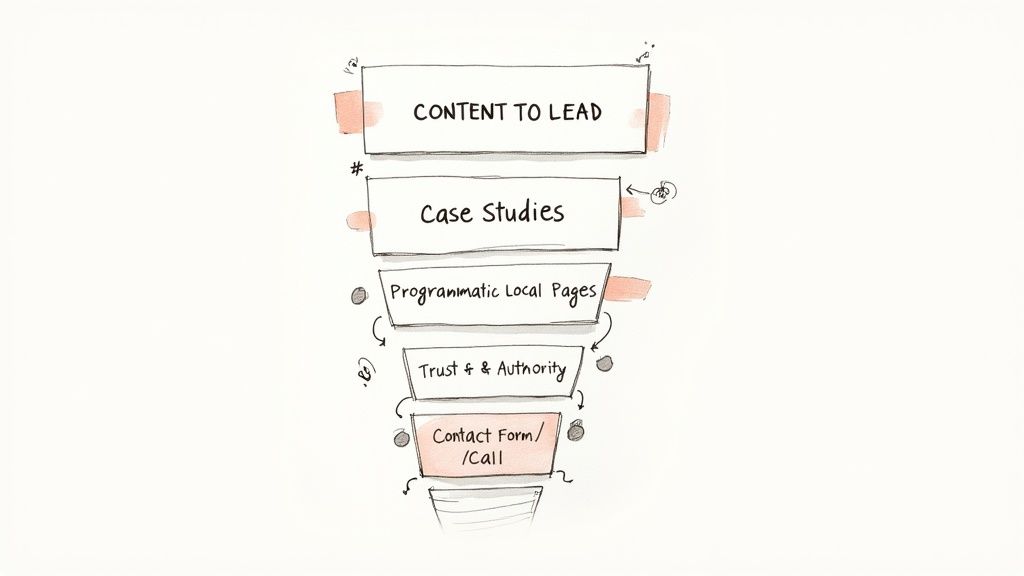
Effective content isn’t about filling a blog with random articles. It’s your single most powerful tool for turning anonymous website visitors into paying clients. For any service business, every single piece of content needs to have a job—whether that’s building trust, proving your expertise, or nudging a potential customer toward a decision.
The real goal is to stop publishing generic advice and start creating assets that solve your ideal client’s most pressing problems. It all comes down to writing with purpose and a relentless focus on conversion.
Go Beyond the Standard Blog Post with High-Value Content
A blog is a great starting point, but to win in a crowded market, you need to create content that showcases your expertise in a way that’s impossible to ignore. These aren’t just articles; they’re tangible proof of the value you deliver.
Two of the most powerful formats that work consistently for service businesses are:
- Detailed Case Studies: Nothing builds trust faster than showing a real-world success story. A great case study isn’t just a sales pitch—it’s a story. Walk the reader through the client’s initial problem (“Our website traffic was stagnant”), detail the specific solution you implemented (“We launched a hyper-local content strategy targeting three key neighborhoods”), and, most importantly, highlight the measurable results (“Within six months, organic leads increased by 150% and we booked 25 new clients directly from the site”).
- Service-Specific Guides: Think of these as in-depth resources that solve a very specific problem for your audience. A financial advisor might create a guide on “How to Choose the Right Retirement Plan,” while an IT consultant could publish “A Cybersecurity Checklist for Small Business Owners.” These guides instantly position you as an authority and work incredibly well as lead magnets.
My Takeaway: Stop thinking of your content as just “blogging.” Start thinking of it as building a library of proof. Every case study and in-depth guide is a sales asset working for you 24/7, convincing potential clients that you’re the only logical choice.
Using AI as Your Content Co-Pilot
The explosion of AI has handed small business owners an incredibly powerful assistant for creating content. When used correctly, AI tools are fantastic for smashing through writer’s block and making your workflow more efficient. The trick is to treat AI as a collaborator, not a replacement for your own hard-won expertise.
Here’s a practical workflow that works:
- Brainstorming and Outlining: Give an AI tool your target keyword (like “water damage restoration”) and ask it for common customer questions, related topic ideas, and a detailed article outline.
- Generating the First Draft: Use that outline to have the AI generate a rough draft. This alone can save you hours of staring at a blank screen.
- Injecting Your Expertise: This is where the magic happens and what separates you from everyone else. Go through that draft and weave in your unique insights, real-world examples, and personal stories. For instance, add a paragraph that starts, “In my 15 years of experience, the biggest mistake homeowners make after a pipe bursts is…” This is the human element that generic AI output can’t replicate.
AI is great at getting the basic structure and information down, but your firsthand experience is what will truly connect with clients and build trust. This balanced approach is paying off for others, too—recent data shows 65% of businesses see better SEO results after adding AI tools to their process. For businesses in highly specialized fields, it’s worth exploring how these principles apply to different models. You can learn more about this in our guide on SEO for SaaS companies.
Scale Your Hyperlocal Reach with Programmatic SEO
For service businesses that cover multiple neighborhoods, cities, or even states, programmatic SEO is an absolute game-changer. It’s a method for using data and templates to create hundreds or even thousands of unique, high-value pages at scale.
Instead of sitting down to manually write a unique page for every single location you serve, you create a master template. Then, you use a database of location-specific details to generate all the variations automatically.
For example, a national house cleaning company could design one master template for their “House Cleaning Services” page and then programmatically spit out unique versions for every city:
- “House Cleaning Services in Brooklyn, NY”
- “House Cleaning Services in Austin, TX”
- “House Cleaning Services in Lincoln Park, Chicago”
Each page can be populated with local testimonials, neighborhood-specific details (“Proudly serving the families of Lincoln Park since 2010”), and relevant local keywords. This strategy allows you to capture a massive amount of hyperlocal search traffic that would be practically impossible to target one by one.
This intense focus on creating deep, valuable content is more critical than ever. In 2025, a staggering 72% of SEO companies view content creation as their single most effective strategy. Why? Because search engines are getting smarter, and users are demanding better, more detailed answers. The average length of a first-page result on Google is now roughly 1,890 words, proving that comprehensive, authoritative content is what wins. For service providers, this means investing in content that genuinely helps your audience is the surest path to attracting and converting customers from organic search.
Building Authority with Smart Link Building
In the eyes of Google, links pointing to your website are basically votes of confidence. But for a local service business, this isn’t a numbers game. It’s about earning the right kind of links. Forget about sheer quantity; quality and local relevance are what truly move the needle for your SEO.
Honestly, a single, solid link from a respected local organization is worth a hundred generic ones from sites that have nothing to do with your community. Our goal is to build a backlink profile that not only boosts your rankings but also sends real, qualified customers your way from sources they already know and trust.
Earn Links by Actually Being Part of the Community
The best links often come from real-world engagement, not from sitting behind a keyboard. When you stop chasing links and start building relationships, you’ll find that link building becomes a natural byproduct of just being a good local business.
Here are a few practical ways to do this that work time and time again:
- Sponsor Local Events: Get involved. Sponsoring a local charity 5k, a youth sports team, or a neighborhood block party almost always gets you a thank-you link on the organizer’s website. That’s a legitimately powerful, locally-relevant link.
- Partner with Complementary Businesses: Who else serves your customers? A wedding photographer could write a guest post for a local venue’s blog titled, “5 Tips for Perfect Wedding Photos at Our Venue.” This helps the venue’s audience and earns you a highly relevant backlink. It’s a classic win-win.
- Get Featured in Local News: Local news outlets are constantly on the hunt for stories. Did you just finish a massive project, win an award, or hire a key new employee? A simple press release often leads to a feature story and a high-authority backlink. Don’t overthink it.
My Two Cents: Stop thinking about it as “building links.” Think of it as “building relationships.” The moment you start actively participating in your community and collaborating with other local businesses, valuable links will start to appear naturally.
Create Link-Worthy Digital PR Assets
Another fantastic strategy is to create simple, shareable content that local bloggers, journalists, and community leaders actually want to link to. This is a basic form of digital PR, and it doesn’t need to be some massive, expensive campaign.
The trick is to create a resource that positions you as the local data expert.
For example, a home remodeling contractor could pull public permit data or run a small local survey to create a simple report like “The Top 5 Most Popular Home Remodeling Projects in Austin This Year.”
This type of content is pure gold because:
- It’s original. Nobody else has this data, making your site the go-to source.
- It’s highly relevant. It speaks directly to what people in your market care about.
- It’s easy to share. Local real estate bloggers and news sites can easily reference your study in their own articles, linking back to you as the source.
This single tactic shifts your perception from just another service provider to an authority on local trends. When you create assets people genuinely want to share, you build a powerful, natural backlink profile that cements your reputation and drives real SEO results.
Tracking SEO Success and Proving ROI
https://www.youtube.com/embed/P9bNJ-S6BZQ
An SEO strategy without measurement is just guesswork. You can pour all the time and money in the world into optimizing your site, but if you can’t prove it’s working, you’re flying blind. For any service business, this means tying every single effort back to tangible results—more phone calls, more quote requests, and more booked jobs.
This isn’t about chasing vanity metrics like “impressions” or “clicks.” It’s about tracking the specific actions that directly lead to revenue. When you can draw a straight line from a keyword ranking to a signed contract, SEO stops being an expense and becomes a powerful, predictable investment.
H3: Setting Up Meaningful Conversion Tracking
Before you can measure success, you have to define what a “win” actually looks like for your business. For service providers, these are almost always lead-generation events. The first and most critical step is getting goal tracking properly configured inside Google Analytics 4 (GA4).
These are the non-negotiable conversions you should be tracking:
- Form Submissions: Every time a prospect fills out your “Request a Quote” or “Contact Us” form, that’s a goal.
- Click-to-Call Actions: On mobile, your phone number should be a clickable link. Tracking these clicks shows you exactly how many calls your site is directly generating.
- Appointment Bookings: If you use an online scheduler like Calendly, you can (and should) track every successfully booked meeting as a conversion.
Getting these set up in GA4 gives you a crystal-clear view of which pages, keywords, and traffic sources are driving the most valuable client actions. This data is the bedrock for making smart, informed decisions about where to focus your efforts next.
H3: The Key Performance Indicators That Actually Matter
With your conversion tracking in place, you can finally start monitoring the Key Performance Indicators (KPIs) that truly reflect business growth. It’s easy to get lost in a sea of data, so it’s vital to focus on the metrics that tell a clear story.
Don’t get distracted by metrics that don’t directly tie to your bottom line. An increase in organic traffic is great, but an increase in qualified leads from that traffic is what truly matters for a service-based business.
Monitoring the right KPIs is crucial for understanding performance. It’s also the first step in calculating the long-term value of a client, which is fundamental to understanding your overall marketing return.
The financial returns from a solid SEO strategy are some of the best in the business. According to recent industry data, the real estate sector can see an ROI as high as 1,389%, while financial services can hit around 1,031%. Across the board, businesses earn about $22 for every $1 spent on SEO. These figures aren’t just impressive; they prove that well-executed SEO is a core driver of profitability. You can find more of these powerful SEO statistics to see how this plays out in different industries.
To keep your analysis sharp and focused, I recommend tracking a core set of KPIs that bridge the gap between website performance and business outcomes.
H3: A Table of Essential KPIs for Service Business SEO
This table breaks down the most important metrics that connect your SEO efforts directly to business results.
| KPI | What It Measures | Tool to Track |
|---|---|---|
| Organic Leads | The total number of form fills, calls, or bookings originating from organic search traffic. | Google Analytics 4 (GA4) |
| Conversion Rate | The percentage of organic visitors who complete a desired action (e.g., submit a form). | Google Analytics 4 (GA4) |
| Keyword Rankings | Your website’s position in search results for your most valuable, high-intent keywords. | Google Search Console, Ahrefs, Semrush |
| Organic Traffic | The total number of visitors who arrive at your site from non-paid search engine results. | Google Analytics 4 (GA4) |
| Cost Per Lead | Your total SEO investment divided by the number of organic leads generated. | Manual Calculation (using GA4 data) |
| Local Pack Visibility | How often your Google Business Profile appears in the local map pack for target searches. | Google Business Profile Insights |
By keeping a close eye on these specific metrics, you’ll always know exactly how your SEO is performing and where you can make improvements.
H3: A Sample 90-Day Rollout Plan
Trying to do everything at once is a classic mistake and a surefire way to get overwhelmed. A phased approach is always better, allowing you to focus on the highest-impact tasks first and build momentum as you go.
Here’s a simplified 90-day plan to get you started:
- Month 1 (The Foundation): Your entire focus should be on the technical audit, deep keyword research, and setting up all of your conversion tracking. This is also the time to fully optimize your Google Business Profile and your core service pages.
- Month 2 (Content & Local Signals): Now you can start executing your content plan. Publish your first couple of high-value blog posts or case studies. At the same time, kick off your local citation building and begin outreach for those crucial initial backlinks.
- Month 3 (Analyze & Refine): It’s time to review your initial data in GA4 and Google Search Console. Which pages are actually getting traffic? Are conversions coming through? Use these early insights to refine your strategy and double down on what’s already working.
This simple roadmap keeps your efforts focused and ensures you’re building a solid foundation for long-term SEO success.
Ready to turn your website into a predictable lead generation engine? At SEO by Tim, we specialize in creating and executing revenue-focused SEO strategies that deliver measurable results. Schedule your free 30-minute discovery call today and let’s build a plan for your growth.





 SEO by Tim