
SEO isn't just another box to check on your marketing to-do list. For SaaS companies, it’s a core growth engine—an asset that builds real, compounding value over time. It creates the kind of predictable, scalable pipeline that paid advertising, for all its speed, simply can't sustain on its own.
Think of it as building a revenue-generating machine that, once running, lowers your customer acquisition costs and strengthens your brand's authority for years to come.
Why SEO Is Your SaaS Company’s Most Valuable Asset
Paid ads are great for a quick hit of traffic. But the second you stop paying, the leads dry up. It’s like renting an audience. SEO, on the other hand, is about owning your audience. You’re building a competitive moat that gets wider and deeper with every piece of content you publish and every link you earn.
Think about how your ideal customers actually operate. Their journey starts with a problem, and that problem almost always leads them straight to a search bar. This is where a smart SaaS SEO strategy wins. You meet them right at their point of need, ready with a solution.
Look at a giant like Atlassian. They didn't build their empire on flashy Super Bowl ads. They got there by methodically and relentlessly capturing search traffic for every term related to project management, bug tracking, and team collaboration. Each article and guide became a permanent asset, pulling in developers and managers day after day, long after hitting "publish." This strategy is a real-world example of the flywheel effect in action: initial efforts compound, driving more traffic, building authority, and ultimately, leading to more sign-ups and demos.
The Compounding Power of Organic Growth
Here’s where the magic really happens. A single, well-ranked article can pull in thousands of highly relevant visitors every single month, for years. Compare that to a paid campaign, which demands constant funding just to stay visible. A top-ranking blog post is your best salesperson, working 24/7 with zero commission.
This fundamentally reshapes your unit economics, driving down your customer acquisition cost (CAC) over the long haul.
SEO is the only marketing channel that truly builds equity. Every piece of content, every backlink, every technical fix—it all adds to your website's authority, making it progressively easier to rank for more competitive terms down the line.
The numbers tell the same story. Research from First Page Sage shows that the average ROI for B2B SaaS SEO can hit an incredible 702%, with many companies breaking even on their investment in just seven months. And with 66% of B2B SaaS buyers relying on search engines to do their research, not showing up is just not an option.
Comparing Long-Term Growth Levers for SaaS
When planning for sustainable growth, it's crucial to understand how different channels contribute to your long-term goals. SEO and PPC are often seen as competitors, but they serve different strategic purposes.
| Growth Attribute | SEO (Organic Search) | PPC (Paid Search) |
|---|---|---|
| Time to Impact | Slower initial ramp-up (3-9 months) | Immediate visibility and traffic |
| Cost Model | Upfront investment in content/tech | Pay-per-click, continuous spend |
| Long-Term Value | Compounding asset, builds equity | Traffic stops when you stop paying |
| Audience Trust | High, seen as more authentic | Lower, clearly marked as an ad |
| CAC Trend | Decreases over time as authority grows | Stable or increases with competition |
While PPC provides valuable short-term data and traffic, SEO is the bedrock of a scalable, cost-effective acquisition strategy that pays dividends for years.
Aligning SEO With the SaaS Customer Journey
A truly effective SEO strategy doesn't just chase keywords; it maps directly to the customer's journey from problem to purchase. You need to be there at every critical step.
- Problem-Aware Stage: They’re just realizing their pain point and searching for answers (e.g., "how to improve team productivity"). Your blog posts and guides should be there to help.
- Solution-Aware Stage: Now they're exploring different types of tools (e.g., "best project management software"). This is where your comparison pages and category-level content shine.
- Product-Aware Stage: They’re zeroing in on specific brands and looking for validation (e.g., "Monday.com vs Asana"). Your alternative pages and case studies close the deal.
By creating targeted content for each of these stages, you build trust and seamlessly guide prospects toward choosing your solution. This approach transforms your website from a simple brochure into a powerful, automated sales funnel. If you want to dive deeper into building a revenue-first SEO framework, check out the model used by consultancies like https://seobytim.com.
Getting Your Technical SEO Foundation Right
Before a single dollar is spent on content, we need to talk about the engine. Your website is that engine, and if it's not tuned for performance, even the most brilliant content will fall flat. A solid technical foundation isn’t just a nice-to-have; it's the absolute starting point for any SEO for SaaS companies that actually drives revenue.
Think of it like this: your content is premium fuel, but if you pour it into a sputtering, leaky engine, you're not getting anywhere fast. Your site has to be dead simple for search engines to crawl, index, and understand what you're all about. That means getting the technical details right from the very beginning.
Nailing Your Site Architecture
First up is a clean, logical site structure. This isn't just for the user experience—it's how you show search engines the hierarchy and relationships between your pages. A prime example of this is HubSpot; their site is organized into clear hubs like "Marketing," "Sales," and "Service," with features and solutions nested logically beneath them.
Let’s imagine you run a CRM platform. A smart URL structure following this model would look something like this:
- Homepage:
yourcrm.com - Feature Hub:
yourcrm.com/features/ - Specific Feature Page:
yourcrm.com/features/email-automation - Solution/Use Case Page:
yourcrm.com/solutions/for-sales-teams
This creates a clear, predictable path for both people and crawlers. It also sets you up perfectly to channel authority from your high-traffic blog posts to these crucial, money-making pages through a thoughtful internal linking strategy.
Sitemaps and Making Sure You're Crawlable
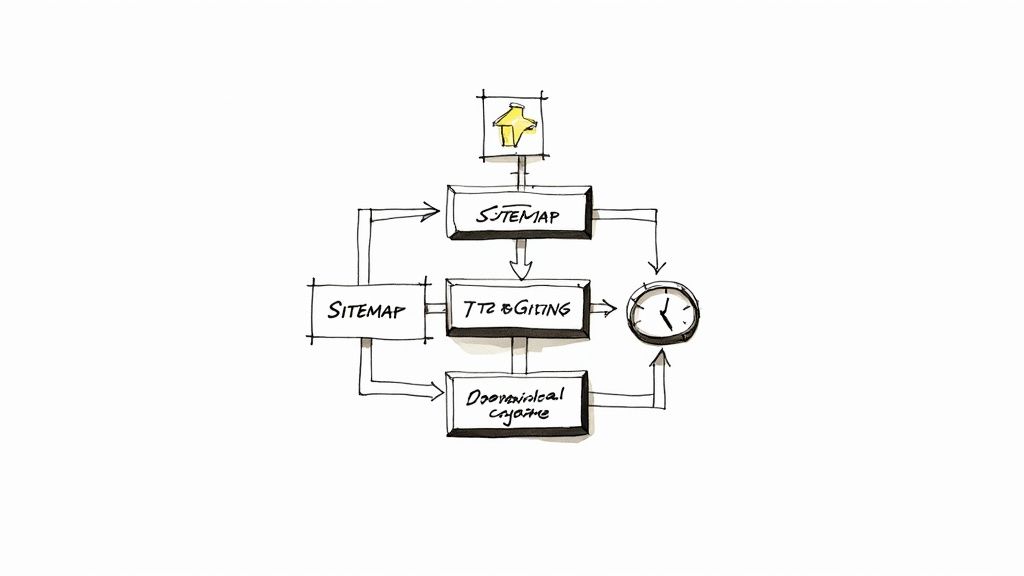
It’s a simple truth: if Google can’t find your pages, you can’t rank. That’s where a sitemap comes in. It's essentially a roadmap you hand over to search engines, listing all the important URLs you want them to crawl and index. Thankfully, most modern CMS platforms like Webflow or HubSpot can generate one for you automatically.
Google's own documentation shows just how simple an XML sitemap is.
This little file tells search engines where your pages are and the last time they were updated, which can help get new content indexed much faster. Once you have your sitemap (usually found at yourdomain.com/sitemap.xml), you need to submit it through Google Search Console. This is a critical step to ensure Google knows it exists.
A well-structured sitemap is your direct line to Google. You're essentially saying, "Hey, these are the pages that matter most to my business. Please crawl and index them."
Tackling Common SaaS Technical Hurdles
SaaS websites often run into some unique technical traps, especially with duplicate content. This is a big problem. It happens when multiple URLs show the exact same content, which splits your ranking signals and confuses search engines.
A common culprit? Tracking parameters added to URLs for marketing campaigns, or even old-school printer-friendly versions of pages. The fix for this is the canonical tag.
It’s a small piece of HTML code (rel="canonical") that tells search engines which version of a URL is the "master copy" that you want to show up in search results. For example, if you have yourcrm.com/features/reporting?source=email and yourcrm.com/features/reporting, the canonical tag on the first URL should point to the second one. This consolidates all that ranking power into a single, preferred URL.
Getting these technical basics locked down means your site is ready for primetime. You're building a clean, fast, and easily understandable foundation that lets every piece of content you create deliver the maximum possible impact.
Crafting a Keyword Strategy That Drives Sign-Ups
Let’s be honest. A keyword strategy can be the difference between attracting random internet browsers and signing up your next paying customer. For any SaaS business, this means getting laser-focused on user intent, not just chasing vanity metrics like search volume.
The goal here is simple: map every single keyword you target directly to a problem your software solves. Think of it as building a pathway that guides prospects from the moment they realize they have a problem all the way to clicking "start free trial." You need to get inside their heads. What words are they typing into Google to describe their frustrations? Nail that, and you've built the foundation for an SEO strategy that actually fuels your sales pipeline.
The Three Pillars of SaaS Keyword Intent
To really make this work, you have to meet users wherever they are in their buying journey. We can break this down into three core keyword categories, each aligning with a different level of customer awareness.
- Problem-Aware Keywords: This is your top-of-funnel. These are people who are just starting to realize they have an issue. They aren't looking for software yet; they're looking for answers. Think "how to improve team collaboration" or "ways to automate customer support."
- Solution-Aware Keywords: Okay, now they know a solution like yours exists and they’re starting to shop around. These middle-of-funnel keywords are often comparative or look for recommendations, like "best project management software" or "Slack alternatives."
- Bottom-of-Funnel Keywords: This is where the magic happens. These folks are ready to pull the trigger. They’re searching for things like "HubSpot pricing," "Asana vs Trello," or "Salesforce demo." Keywords like these scream purchase intent and are absolutely critical for driving sign-ups.
A solid content plan needs a healthy mix of all three. The problem-aware content builds your audience and establishes you as an authority, while the bottom-of-funnel content is there to catch high-intent leads when they’re ready to buy.
Uncovering High-Intent Keywords with Precision
Generic keyword research just won’t cut it. You need a repeatable process for digging up the terms that signal a user is ready to make a move. This is where a tool like Ahrefs' Keyword Explorer becomes your best friend, helping you peek at what competitors are doing and find gaps you can exploit.
For example, here's a quick look at the keyword "best crm for small business."
This screenshot doesn't just show us search volume. It reveals keyword difficulty and, more importantly, the cost-per-click (CPC), which is a fantastic indicator of commercial intent. If people are paying good money to advertise on a keyword, you can bet it converts. An actionable takeaway is to run a "content gap" analysis to find keywords your competitors rank for but you don't—this can uncover some seriously quick wins.
A keyword like "crm software" has massive search volume, but the intent is all over the place. A query like "crm with email automation for sales teams," on the other hand, has lower volume but is infinitely more valuable. It tells you exactly what problem the user needs to solve.
The payoff for getting this right is huge. A study by HubSpot found that 81% of marketers report that SEO delivers better quality leads than PPC. It makes sense—organic search captures people who are doing their homework. And when you consider that the top three search results snag 54.4% of all clicks, ranking for these high-intent terms is non-negotiable. If you want to dive deeper, the team at Powered by Search has some great insights on this.
From Keywords to Content: A Repeatable Framework
Once you’ve got your list of golden keywords, you need to match them to the right content format. Creating a simple framework ensures you're building assets that actually meet user expectations.
Here's a straightforward way to think about mapping your keywords to content and the user's intent.
Mapping SaaS Keywords to Content and Intent
| User Journey Stage | Keyword Type (Example) | Ideal Content Format |
|---|---|---|
| Problem-Aware | "how to track sales leads" | In-depth blog post or guide |
| Solution-Aware | "best sales crm" | Comparison article or listicle |
| Bottom-of-Funnel | "Pipedrive alternatives" | Dedicated "vs." landing page |
| Brand-Focused | "Pipedrive pricing" | Pricing or feature page |
This kind of structured approach stops you from just creating content for the sake of it. Instead, you're building a strategic library of assets, each designed to attract, educate, and convert. It’s also a powerful way to build brand recognition over time. If you're curious about that, you can learn more about how branded search volume is a ranking signal in our comprehensive guide.
At the end of the day, an effective SaaS keyword strategy comes from a deep, almost obsessive, understanding of your customer. It’s about translating their problems into a content plan that gives them real value, making your product the obvious and only choice when it’s time to buy.
Creating Content That Turns Prospects Into Customers
A killer keyword strategy is your roadmap, but content is the fuel for your entire SaaS SEO engine. It’s how you turn search visibility into actual trial sign-ups and paying customers. The real goal here is to build a library of assets that don't just pull in traffic, but actively guide people from discovery to decision.
This isn’t about publishing random blog posts and hoping for the best. You need a structured game plan that cements your brand as the go-to authority on the problems your software solves. One of the most effective ways I've seen this done is with the pillar and cluster model.
Build Unshakeable Authority with the Pillar and Cluster Model
Think of a pillar page as your magnum opus on a core topic. It’s the comprehensive, central hub your business absolutely needs to own. If you’re a SaaS company selling developer tools, your pillar might be a massive guide on "API Management." This page would cover the topic from a 10,000-foot view, but with serious authority.
Then, you support that pillar with a bunch of "cluster" articles. These are much more specific, deep-dive pieces that explore niche subtopics, like:
- "REST vs GraphQL APIs: Which is Right for Your Project?"
- "API Security Best Practices You Can't Ignore"
- "How to Actually Monitor API Performance and Uptime"
Every single one of these cluster articles links back up to your main pillar page. This sends a powerful signal to Google that you have deep expertise on the subject, which in turn boosts the authority and rankings for all the related content.
The beauty of this model is its logic. It organizes your content perfectly for both human readers and search engine crawlers. You're basically building a web of interconnected, expert-level information that makes your site the definitive resource.
The diagram below shows how different types of content map to the user's journey, from just realizing they have a problem to being ready to buy.
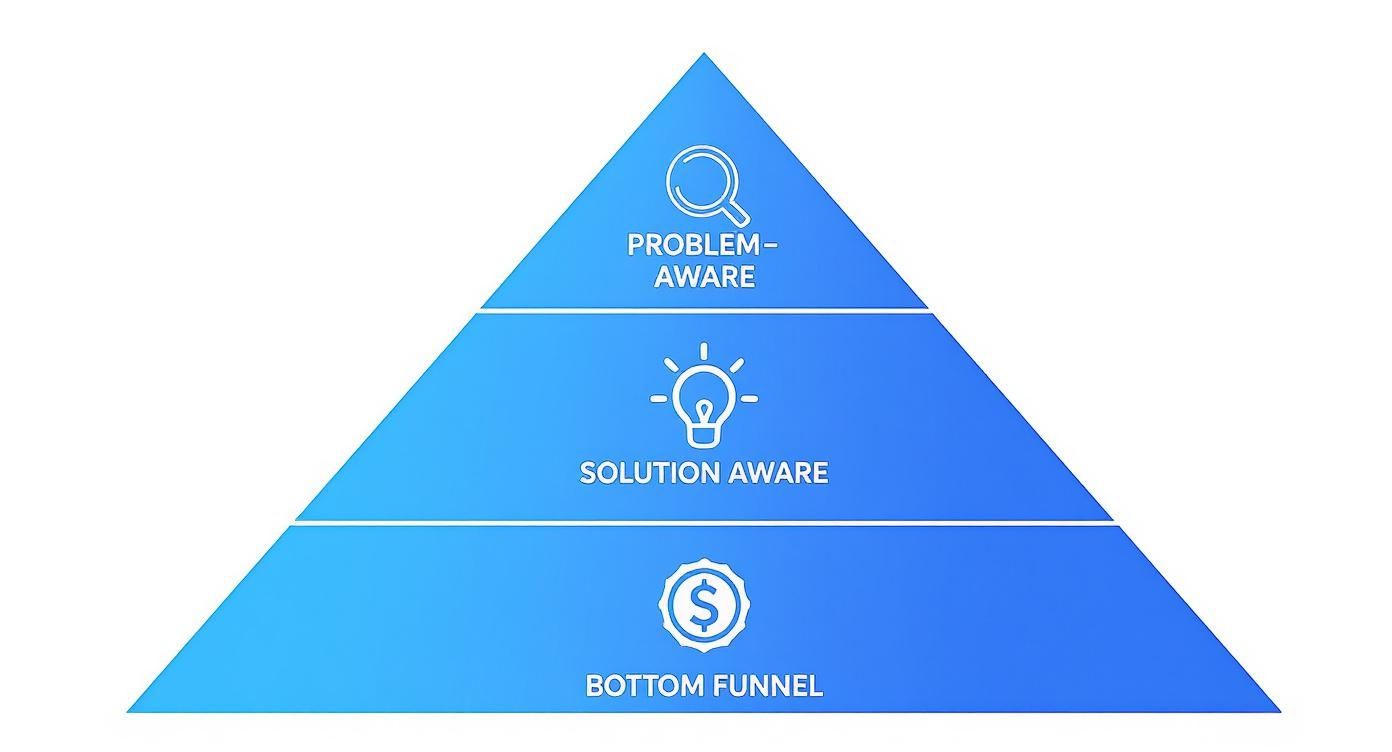
This hierarchy shows why you need a mix of content. You have to capture people at every stage, but those bottom-of-funnel pages are your most direct line to revenue.
Scale Your Content Machine with Programmatic SEO
The pillar model is fantastic for establishing deep authority, but some SaaS businesses can hit hyper-growth by using programmatic SEO. This is all about creating hundreds—or even thousands—of templated landing pages from a structured dataset.
Zapier is the undisputed king of this strategy. They’ve built a unique landing page for almost every software integration imaginable, like "Connect Gmail to Slack" or "Connect Asana to Google Sheets." Each page uses a consistent template but is filled with unique data, targeting an enormous volume of long-tail keywords.
This approach is a goldmine for SaaS companies that have:
- Integrations: Create a page for every single tool your product connects with.
- Use Cases: Build out pages for different industries or roles (e.g., "project management for marketing teams").
- Templates: Offer a gallery of pre-built templates for your product (e.g., "Airtable templates for content calendars").
With programmatic SEO, you can expand your organic footprint at a scale that manual content creation could never match, capturing highly specific, high-intent search traffic along the way.
Zero In on Your Bottom-of-Funnel Conversion Assets
Top-of-funnel content builds an audience, but it's your bottom-of-funnel (BoFu) assets that directly drive revenue. These pages target users who are actively comparing solutions and are this close to buying. Making these a priority is a fundamental principle of smart SEO for SaaS companies.
Two of the highest-impact BoFu content types are:
- Competitor Comparison Pages: Pages titled "[Your Brand] vs [Competitor]" or "[Competitor] Alternatives" are absolute conversion machines. They give you the power to control the narrative, highlight your unique selling points, and tackle customer objections head-on.
- Feature-to-Benefit Deep Dives: Ditch the generic features list. Instead, create in-depth articles that frame each feature as the solution to a specific customer pain point. For example, instead of just "Email Automation," write a piece on "How to Save 10 Hours a Week with Automated Email Workflows."
These pages should be at the top of your to-do list. They attract people with clear commercial intent and are often the very last thing a prospect reads before hitting "start trial" or "request demo." For more practical tips on building out a conversion-focused content strategy, the SEO by Tim blog is packed with great resources.
By combining broad authority-building with laser-focused conversion content, you create a powerful system that turns search traffic into predictable growth.
Acquiring Links That Build Authority and Trust
Let's be clear: content and technical SEO get you to the starting line. But in the hyper-competitive SaaS world, a powerful backlink profile is what puts you in the winner's circle. Backlinks—links from other websites pointing to yours—are still one of Google's biggest signals for authority. It's how the algorithm understands that real people and reputable brands trust you.
Of course, this isn't about chasing hundreds of spammy links like it was a decade ago. That game is over. For a modern SEO for SaaS companies, success means earning high-quality, relevant links that build genuine authority and, just as importantly, send you referral traffic that converts.
Turn Original Data into a Link Magnet
Want to know the secret to getting top-tier publications to link to you? Give them something they can't get anywhere else: original data. Journalists and industry bloggers are always hungry for fresh statistics and compelling insights to back up their stories. When you create and publish your own research, you're not just creating content; you're creating a linkable asset.
For a SaaS business, this can take a few different forms:
- Survey your users: If you run a project management tool, why not survey 1,000 project managers on the biggest hurdles they face with remote teams? The results are pure gold for articles on the future of work.
- Analyze your own data (anonymously, of course): A social media scheduling platform could analyze millions of posts to find the real best times to post on Instagram. That’s a headline waiting to be written.
- Create an industry benchmark report: A cybersecurity SaaS could compile data on the most prevalent threats targeting SMBs over the last year. This becomes a go-to resource for an entire industry.
Once your report is live, it’s time for promotion. This isn't a "publish and pray" situation. You need to do targeted outreach. Find the journalists at places like TechCrunch or key industry blogs who have covered similar topics before. A short, direct email giving them a first look at your findings can work wonders.
Build Real Relationships with Guest Posting
Guest posting still works, but only if you stop thinking of it as a cheap trick for links. It's a relationship-building tool. Your goal isn't to blast out a hundred generic pitches; it's to strategically place your expertise on a handful of blogs that your ideal customers actually read and trust.
Forget about metrics alone for a second. Find sites with a genuinely engaged audience and high content standards. A single, well-written guest post on a respected industry authority's blog is worth more than ten links from random, low-traffic sites.
When you do your outreach, make it personal. Mention a recent post they published. Pitch a few unique, data-driven ideas that solve a real problem for their readers. Show them you've done your homework.
Stop treating guest posting as a one-off transaction. It's your chance to build a long-term partnership. The best guest posts lead to co-marketing webinars, podcast appearances, and more organic links down the road because you've become a trusted name in their network.
This approach builds your company’s authority and your personal brand at the same time.
Claim Your Unlinked Brand Mentions
This is probably the lowest-hanging fruit in all of link building. It's also one of the most effective. Unlinked mentions are exactly what they sound like: another website writes about your company, your product, or even your CEO, but they forget to link back to your site.
They've already done the hard part by endorsing you. All you have to do is give them a gentle nudge.
You can find these opportunities easily using tools like Ahrefs' Content Explorer or by setting up simple Google Alerts.
Here’s a simple process that just works:
- Set up alerts: Monitor your company name, product names, and key executives.
- Scan for opportunities: Regularly check for new mentions that don't have a link.
- Find the right person: Figure out who wrote the piece and track down their email.
- Send a friendly note: A quick, polite email thanking them for the mention and asking if they’d mind adding a link is all it takes.
The success rate here is incredibly high. The request is small, and the writer has already signaled that they find your brand valuable. It's a simple way to score some fantastic, contextually relevant links with minimal effort.
Forget Vanity Metrics—Let's Talk About Revenue
Huge traffic charts and a long list of keyword rankings look great in a report, but let's be honest—they don't pay the bills. When we talk about real SEO for SaaS companies, the only thing that matters is how it impacts the bottom line. It's time to stop chasing vanity metrics and start focusing on what your leadership team and investors actually care about.
The real goal is to draw a straight line from a blog post to a new paying customer. We need to track the metrics that signal real business growth: new trial sign-ups, qualified demo requests, and most importantly, new monthly recurring revenue (MRR) coming directly from organic search.
Getting Conversion Tracking Right in GA4
Your entire measurement system starts with Google Analytics 4 (GA4). To get any meaningful data out of it, you first have to teach GA4 what a "win" actually looks like for your SaaS business. This means setting up specific conversion events.
For most SaaS companies, the mission-critical conversions are usually:
- Trial Sign-Up: A user successfully starts a free trial of your product.
- Demo Request: A lead fills out a form to see a product demo with your sales team.
- Newsletter Subscription: A visitor signs up for your email list, showing clear interest.
Once you have these configured, you can pinpoint exactly which organic landing pages are driving these crucial actions. This is where the magic happens.
An actionable insight is to use the "Landing page + query string" report in GA4. You can filter specifically for organic traffic and then add a "Conversions" column. Suddenly, you're not just looking at page views; you're seeing which URLs are actually generating leads.
Connecting the Dots from Conversions to MRR
Tracking events in GA4 is just the first step. The real power comes when you connect that data to actual revenue. This is how you prove, without a doubt, the value of your SEO and content efforts.
By cross-referencing the users who completed a conversion event in GA4 with new customers in your CRM or payment platform (like Stripe), you can attribute real MRR back to specific pieces of content.
For instance, you might find that your "Best Slack Alternatives" article drove 35 trial sign-ups last month. Digging a little deeper, you see those trials turned into five new paying customers, adding $1,200 in new MRR. Now that is a powerful story to tell in your next meeting.
This kind of tracking fundamentally changes the conversation around content. It’s no longer a cost center. It’s a portfolio of revenue-generating assets, each with a clear, measurable ROI.
This data-driven approach gives you a roadmap for what to do next. You can clearly see your most valuable content and confidently double down on what’s already working. To see how to build this system from the ground up, check out our deep dive on revenue-driven SEO. It’s a complete game-changer for proving your impact.
Ready to turn your SEO into a predictable source of revenue? SEO by Tim is a consultancy focused on building scalable, conversion-oriented SEO programs for SaaS companies. Book a free 30-minute discovery call to map out your path to sustainable organic growth.
Article created using Outrank




 SEO by Tim