
Before you can even think about your content strategy, you have to get your technical house in order. This is the bedrock of your entire SEO effort. If your site’s technical foundation is shaky, even the most brilliant content will fall flat.
Building Your Technical SEO Foundation
Think of technical SEO as the essential groundwork that allows search engines to find, crawl, and understand what your SaaS is all about. Skipping this step is like building a skyscraper on a swamp—it's just not going to end well. For example, a B2B SaaS company I audited discovered thousands of auto-generated user profile pages were being indexed, diluting their domain authority and hiding their valuable marketing pages from Google. This isn't just about avoiding penalties; it's about creating a smooth, fast, and accessible experience that amplifies every other marketing effort you make.
A solid technical setup directly impacts how both users and search engine bots see your site. I've seen too many SaaS companies inadvertently shoot themselves in the foot with common issues like indexation bloat from thousands of free trial pages or a clunky mobile experience. The goal here is simple: remove every possible obstacle that could stop Google from giving your pages the rankings they deserve.
Conducting a Focused SaaS Site Audit
The first real step is a thorough site audit, but not just any generic checklist. You need to look for problems that specifically plague SaaS businesses. This means hunting down any crawlability or indexing issues that are preventing your most important pages from being seen.
Here are the usual suspects I look for first:
- Indexation Bloat: Do you offer free trials or have user-generated content? These can create thousands of low-quality, thin-content pages that get indexed and dilute your site's authority. Actionable Insight: Use the
site:yourdomain.comsearch operator in Google to get a rough count of your indexed pages. If the number is wildly higher than your number of core marketing pages, you likely have an indexation problem. - Poor Mobile Experience: It’s 2024. More than half of all web traffic is mobile. A frustrating mobile experience is a guaranteed way to lose rankings and customers. Real-Life Example: A client saw a 15% drop in trial sign-ups that correlated directly with a Google algorithm update favoring mobile-friendly sites. Their sign-up form was nearly unusable on a phone.
- Slow Site Speed: Page load time isn't just a tie-breaker; it's a core ranking factor. For a SaaS business, a slow-loading pricing page can be the direct cause of a lost trial sign-up. Tools like Google's PageSpeed Insights are a great starting point for diagnostics.
One thing that often gets missed is the long-term health of your site's infrastructure. It's not a one-and-done task. For instance, recent data shows that over 66% of backlinks eventually break. If you're not running regular audits to catch these, your hard-earned authority is literally disappearing. You can find more SEO statistics and research to keep in mind at https://seobytim.com.
Optimizing for Crawlability and Speed
Once you've identified the problems, it's time to get to work. If you're dealing with indexation bloat from user-generated pages, the noindex tag is your best friend. Applying it to pages that offer no public search value tells Google to ignore them and focus its precious crawl budget on your high-impact marketing content instead.
When it comes to speed, the low-hanging fruit is usually image compression, minifying your CSS and JavaScript, and leveraging a content delivery network (CDN). Actionable Insight: Compress all PNG and JPEG images on your key landing pages using a tool like TinyPNG before uploading. This simple step can often shave a full second off load times. Every millisecond you can shave off your load time matters, especially on those money pages like your demo request and pricing tables.
Technical SEO can feel overwhelming, I get it. But breaking it down into these smaller, targeted fixes makes it entirely manageable.
Implementing Software Application Schema
Finally, don't make Google guess what your product is. Use schema markup to explicitly tell it. Structured data gives search engines the context they need to understand your content, which can lead to those fancy, rich results in the search listings. For any SaaS company, the SoftwareApplication schema is non-negotiable.
Here’s a snapshot from Google’s own documentation showing how you can mark up your app with key details like its price, user ratings, and compatible operating systems.
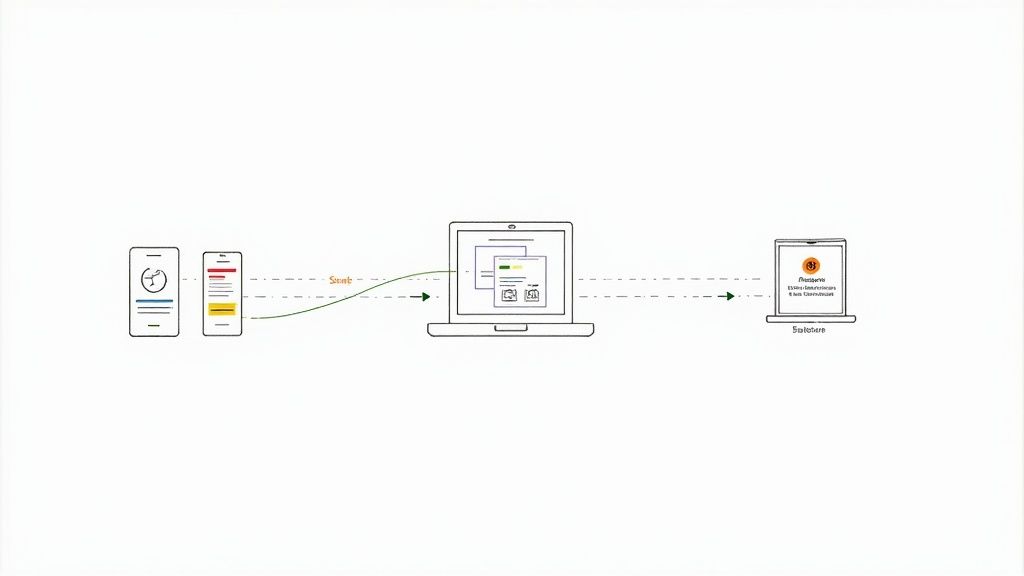
Adding this simple piece of code is one of the easiest ways to make your product stand out. Evidence: A study by CXL found that search results with rich snippets (like star ratings) can increase click-through rates by up to 30%. Those little star ratings and pricing details can make a huge difference in whether a searcher clicks on your result or a competitor's.
Crafting a Keyword Strategy That Drives Revenue
Let's be honest: for a SaaS company, website traffic means nothing if it doesn't lead to paying customers. A winning SEO strategy isn't about chasing the biggest, flashiest keywords. It's about getting in front of people who are actively looking for the exact solution you provide.
This means you have to be deliberate, mapping your entire keyword strategy to the customer's journey. You'll need to think about everyone from the prospect who just realized they have a problem to the buyer who's got their credit card out. When you do this, every piece of content you create has a clear, revenue-focused job, intercepting customers right when they need you most.
Mapping Keywords to the Customer Journey
The heart of a great SaaS keyword strategy is getting inside the searcher's head. What's their intent? Someone typing "how to improve team productivity" is in a completely different stage than someone searching "Asana vs Trello." The first person is exploring a problem; the second is making a buying decision.
We can break this down into three key stages of awareness:
- Problem Aware: They feel the pain but don't know the cure. They're using broad, informational search queries to understand their challenge.
- Solution Aware: Now they're actively researching types of solutions. They're looking into different categories, methods, and tools that could solve their problem.
- Product Aware: This is the finish line. They're comparing specific brands, looking for pricing, reviews, and alternatives to make a final choice.
When you sort keywords this way, you can build a content plan that systematically guides people toward a demo or sign-up.
So many companies make the mistake of pouring all their resources into high-volume, top-of-funnel keywords. While that content builds awareness, it's the bottom-of-funnel, product-aware terms that consistently deliver the highest conversion rates and a much faster ROI.
To help you organize this process, here's a simple framework I use to map keywords to intent and content types.
SaaS Keyword Intent Mapping Framework
This table breaks down how to align your content with user intent at each stage of the sales funnel. It's a practical way to ensure you're creating assets that meet your audience where they are, guiding them from problem awareness to product purchase.
| Funnel Stage | User Intent | Example Keyword Patterns | Content Type |
|---|---|---|---|
| Top-of-Funnel (ToFu) | Informational | "how to," "what is," "best ways to," "guide" | Blog Posts, Guides, eBooks |
| Middle-of-Funnel (MoFu) | Investigational | "best [tool category]," "templates," "tools" | Feature Pages, Use Cases, Webinars |
| Bottom-of-Funnel (BoFu) | Transactional | "[competitor] alternative," "[your brand] vs," "pricing" | Comparison Pages, Pricing Pages |
By using this framework, you're not just guessing what to write about; you're building a strategic content machine designed to attract and convert high-quality leads.
Prioritize Bottom-of-Funnel Keywords First
While you absolutely need a full-funnel approach for long-term growth, I always advise clients to start with bottom-of-funnel (BoF) keywords. Why? Because these searchers are ready to buy. Quick wins here can build momentum and prove the value of SEO to your leadership team.
These high-intent BoF keywords usually follow a few predictable patterns:
- Competitor Alternatives:
[competitor] alternative - Direct Comparisons:
[your brand] vs [competitor] - Use-Case Specific:
project management software for small teams - Branded Search: Any search that includes your company name. A strong brand is a massive advantage, and as you'll see in our guide, branded search volume is a key indicator of market authority in our guide.
Think about it. A project management tool like Asana doesn't just try to rank for "project management software." They go after the money terms by creating pages specifically for "Trello alternative" and "Asana vs Monday." They're capturing users who are literally one search away from making a decision.
The Power of Product-Led SEO
Here’s a strategy that’s uniquely powerful for SaaS: product-led SEO. This isn't about writing blog posts about your features. It's about turning your product's features, use cases, and templates into organic search magnets themselves.
Real-Life Example: Look at Asana again. They have landing pages built around terms like "Gantt chart software" and "Kanban board tool." These aren't just informational articles; they are high-intent landing pages that attract someone looking for a specific capability, and then immediately show how Asana's product is the perfect solution. It’s the most direct path from problem to conversion.
Find Your Best Keywords by Spying on Competitors
One of the fastest ways to build a revenue-focused keyword list is to see what's already working for your competition. Tools like Ahrefs or Semrush let you peek under the hood and see the exact keywords driving traffic and sales to their sites.
Actionable Insight: Don't just look at their top-level traffic numbers. In your tool of choice, filter their top pages to only show URLs that contain /vs/, /alternatives/, or /pricing. I guarantee these pages are driving their sign-ups. By identifying these high-value keywords, you can spot gaps in their strategy and create something even better to steal that traffic.
Architecting Content That Converts and Scales
A solid keyword strategy tells you what to write about. A smart content architecture tells you where it all goes and how it fits together. If you’re just publishing a random stream of blog posts, you're pretty much guaranteeing most of your effort will go to waste. For SaaS SEO to actually drive revenue, every single article needs to be part of a bigger plan—an interconnected ecosystem that pulls users from discovery all the way to a demo request.
This is where structure becomes your secret weapon. The real goal isn't just to rank for a handful of terms; it's to build a content machine that establishes your brand as the authority on a core topic. This is how you systematically build topical authority, which is just a fancy way of saying you're teaching Google that you're the expert in your space.
The Hub and Spoke Model in Action
One of the most battle-tested ways to organize your content is the Hub and Spoke model (you'll also hear it called the topic cluster model). This isn’t some abstract theory; it’s a practical framework that I’ve seen work time and time again to help companies completely own a subject area in the search results.
It’s pretty simple in concept:
- The Hub: This is your big, foundational pillar page. Think of it as your "Ultimate Guide to [Your Core Topic]." It covers a broad, high-value subject from a high level, touching on all the important sub-topics without getting lost in the weeds on any single one.
- The Spokes: These are the deep-dive articles that branch off from the hub. Each spoke zeroes in on a specific sub-topic mentioned in the hub, targeting a more focused, long-tail keyword.
- The Links: This is the magic that ties it all together. Every spoke article links back up to the main hub page, and the hub, in turn, links out to all its supporting spokes. This internal linking is crucial because it funnels authority to your most important page (the hub) and creates clear, logical paths for both users and search engine crawlers.
Real-Life Example: Imagine you're a project management SaaS. Your "Hub" could be a massive guide on "Agile Project Management." The "Spokes" would then be detailed articles like "What Are Sprints," "How to Use Kanban Boards," and "A Deep Dive into Scrum Master Roles."
Scaling Content Programmatically Like Zapier
For a lot of SaaS businesses, the real gold is in figuring out how to create content for thousands of nearly identical search queries. That’s where programmatic SEO enters the picture. It’s all about using templates and data to generate unique, valuable pages at a massive scale.
Zapier is the undisputed king of this approach. They’ve built out thousands of landing pages targeting queries like "[App A] + [App B] integration." Each page uses a consistent template but is filled with unique data about that specific integration. The result? A genuinely useful resource for a user with a very specific problem.
Another classic programmatic play is creating "[Your Product] vs [Competitor]" or "[Competitor] Alternative" pages. Actionable Insight: Build one solid comparison page template outlining features, pricing, and key differentiators. Then, you can spin up hundreds of these bottom-of-the-funnel pages that capture people who are literally in the final stages of making a purchase. It’s a systematic way to dominate a huge number of high-intent keywords without having to write every single page from scratch.
Key Takeaway: Programmatic SEO isn't about churning out spam. It’s about spotting patterns in user intent and using technology to create helpful, structured content at a scale that would be impossible to do manually.
The connection between content and SEO is the primary growth engine for most SaaS companies. We all know it's important, but the stats tell a different story—only about 29% of marketers feel their strategies are actually working. Interestingly, companies that bring in specialized agencies tend to grow 2.3 times faster, which really shows the value of having an expert guide the execution. And as for AI? Trust is still incredibly low, with just 4% of marketers relying on it completely, proving that a human touch remains essential.
Aligning Content with the Sales Funnel
Every piece of content you create needs a job to do, and that job should be tied directly to a stage in your buyer's journey. Are you trying to attract someone who doesn't even know they have a problem, or are you trying to convince someone who is comparing you against two competitors?
This infographic breaks down how to map your content to the classic awareness, consideration, and decision stages.
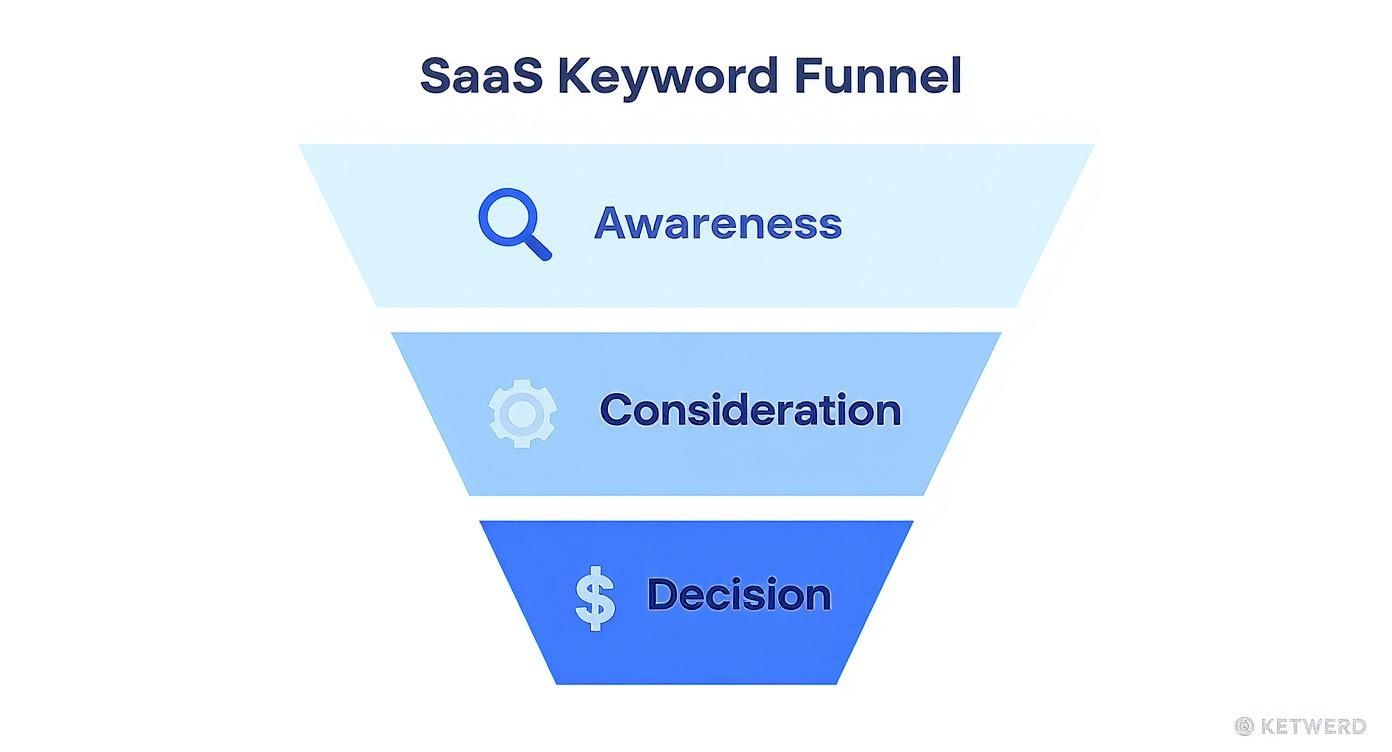
As you can see, people's searches get more specific and transactional as they move down the funnel. Your content strategy has to mirror this journey. Top-of-funnel blog posts are great for casting a wide net, but you absolutely need those hard-hitting comparison pages and feature breakdowns to actually close the deal. You can find more ideas for engaging users at every stage by exploring different strategies on our SEO blog.
Acquiring High-Authority Links That Build Trust
In SaaS SEO, backlinks are the currency of trust. Think of them as referrals from other respected players in your space. When a high-authority site links to you, it's a powerful signal to Google that your content is credible, which is exactly what you need to start ranking for those competitive, bottom-of-funnel keywords.
Forget the old-school, spammy tactics like buying links. That’s a fast track to getting penalized. Today’s game is all about earning genuine endorsements that not only boost your domain authority but also drive referral traffic that actually signs up. It’s a classic case of quality over quantity.
Create Original Data for Digital PR
One of the most powerful ways I’ve seen to earn top-tier links is to become the source of new information. Journalists and industry bloggers are constantly on the hunt for fresh data and compelling stats to back up their stories. This is your opening.
This doesn't mean you need a massive R&D budget. You can get scrappy and creative.
- Analyze your own product data: Dig into your anonymized user data to find interesting trends. Real-Life Example: An email marketing SaaS I know published a report on "The Best Times to Send Emails in 2024," packed with proprietary insights. It was picked up by three major marketing publications, earning them high-authority links and thousands of referrals.
- Run industry surveys: Use a tool like SurveyMonkey or even just a well-designed Google Form to poll your audience or a group of professionals on a hot-button topic. Then, turn the results into a compelling report or infographic.
The entire point is to create a unique, citable asset. When you publish your own findings, you're not just creating content—you're creating a link magnet. Top industry blogs and even news outlets will reference your work, sending high-authority links your way without you ever having to ask.
Leverage Integrations for Co-Marketing Links
Your software isn't an island; it’s part of your customers' tech stack. Every single tool your product integrates with represents a golden opportunity for a link-building partnership. This is a strategy that’s almost tailor-made for SaaS because the links are incredibly relevant and are built on an existing business relationship.
First, just make a list of all your integration partners. Then, start reaching out to their marketing folks to see where you can team up on content.
Actionable Tip: Propose a joint webinar, a co-authored blog post, or a feature in each other’s newsletters. The easiest win? Getting your company listed on their "Integrations" or "App Marketplace" page. This almost always comes with a high-authority, do-follow link from a perfectly relevant site.
Let’s say your project management tool plugs into Slack. A guest post on Slack's blog about "How to Supercharge Team Productivity with [Your Tool] and Slack" is a no-brainer. It gives their audience real value and earns you a powerful, contextually relevant backlink that can drive some of your best-qualified traffic.
Build Real Relationships with Editors
Let’s be honest: cold email outreach for backlinks has an abysmal success rate. It's impersonal, transactional, and most of it goes straight to the trash folder. A far better approach is to focus on building genuine relationships with the editors and writers who actually cover your industry.
Start small. Identify a handful of key publications you’d love to be featured in. Follow their writers on social media, leave thoughtful comments on their articles, and share their work with your own audience. The idea is to get on their radar in a positive, helpful way long before you ever ask for anything.
Once you’ve built that familiarity, your outreach becomes much warmer. Instead of a generic "link to my post" email, you can try something like:
- Offer a unique insight: "Hi [Editor's Name], I just read your piece on [Topic] and loved your point about X. Funny enough, our own data just uncovered a surprising trend that builds on this…"
- Provide an expert quote: "I'm the founder of [Your SaaS], and I've spent the last decade working on [Problem]. If you ever cover this topic again, I'd be happy to share an expert quote."
This relationship-first approach turns link building from a spammy numbers game into a real strategic partnership. Sure, it takes more time, but the links you get are infinitely more valuable and sustainable. You're not just getting a link; you're cementing your brand as a trusted authority in your niche.
Measuring SEO Success by Tying It Directly to MRR
Let's be honest. Traffic, rankings, domain authority… they’re all fine, but they're vanity metrics. For a SaaS business, the only number that truly moves the needle is Monthly Recurring Revenue (MRR). When you stop chasing keyword rankings for their own sake and start focusing on tangible business outcomes, you transform SEO from a cost center into a predictable growth engine.
This means we need to stop asking, "How much traffic did we get?" and start asking, "How many qualified leads, trial sign-ups, and new paying customers did organic search deliver this month?" Answering that question requires drawing a straight line from a Google search to a credit card swipe.
Connecting SEO Activity to Actual Revenue
First things first, you need rock-solid conversion tracking that mirrors how your business actually makes money. A simple "thank you" page confirmation just won't cut it for most SaaS models. The journey from a prospect's first click to becoming a paying customer is often a winding road involving free trials, demos, and multiple chats with your sales team.
Your analytics have to map this entire journey. Here’s how to do it:
- Configure Meaningful Goals: In Google Analytics 4, set up specific goals for the actions that matter—demo requests, free trial sign-ups, and maybe even key resource downloads.
- Integrate Your CRM: This is non-negotiable. You have to connect your analytics to your CRM, whether it's HubSpot or Salesforce. This is the only way to track a user from their first organic visit all the way through the sales pipeline until they become a paying customer.
- Use Smarter Attribution: Ditch last-click attribution. Use data-driven models to understand which organic touchpoints actually influenced the final sale, not just the one that happened right before it.
The real magic happens when you can connect a specific keyword to a new customer. When you can walk into a meeting and say, "Our content on '[competitor] alternative' drove $5,000 in new MRR last quarter," you’ve unlocked the power of revenue-driven SEO. To dig deeper into this mindset, check out our guide on how to build a revenue-driven SEO strategy.
How to Calculate the Real ROI of Your SEO Efforts
Once your tracking is dialed in, calculating the return on your investment becomes surprisingly straightforward. The basic formula is simple: (Revenue from SEO – Cost of SEO) / Cost of SEO. The trick, of course, is getting the inputs right.
Revenue from SEO: This is the number of new customers from organic search multiplied by your average customer lifetime value (LTV).
Cost of SEO: This includes everything you spend to make it happen:
- Salaries for your in-house team
- Agency or freelance retainers
- Software subscriptions like Ahrefs or Semrush
- Your content creation budget
When you get this right, the payoff is huge. Data shows that SaaS SEO delivers an average ROI of an incredible 702%, and it often breaks even on the initial investment in just seven months. Now, the execution is where many SaaS marketers falter—only 29% feel their efforts are very effective. But the financial upside, as these B2B SaaS SEO stats from Powered by Search show, is undeniable.
Beyond the Numbers: Proving Your Value to Stakeholders
Presenting your success to leadership isn't about showing off a traffic graph. It's about storytelling with data. You need to show them precisely how organic search is pushing the company’s most important goals forward.
Actionable Insight: Use cohort analysis to prove the long-term value of customers you bring in. Especially for B2B SaaS with long sales cycles, it might take 6 to 12 months to see the full financial impact of your work. By tracking cohorts, you can demonstrate that users who found you organically have higher retention rates or a greater LTV than customers from other channels.
This is how you get more budget. This is how you earn a permanent seat at the growth strategy table.
Got Questions? We've Got Answers
If you're diving into SEO for your SaaS, you've probably got a few questions buzzing around. Let's tackle some of the most common ones I hear from founders and marketing leaders.
How Long Does This SEO Thing Actually Take to Work?
This is the big one, isn't it? The honest answer is, it's a marathon, not a sprint. You'll likely start seeing some early signs of life—think small ranking bumps for longer, less competitive keywords—within 3 to 6 months.
But for the results that really move the needle, like ranking on page one for those high-value, demo-request-driving terms? You should realistically budget 6 to 12 months of consistent, focused effort. Sometimes longer. SEO is all about building momentum, and that just doesn't happen overnight.
Several things can speed up or slow down your timeline:
- Starting Line: A brand-new domain is like starting from a dead stop, while a site with some history and authority has a running start.
- The Competition: Trying to rank for something like "CRM software" is a whole different ballgame than a niche term for a specific industry.
- Pace & Quality: A disciplined approach—like shipping one truly great, optimized article every week—will get you there much faster than random acts of content.
Technical SEO vs. Content: What's More Important?
It's a classic chicken-and-egg question, but the truth is you absolutely need both. They're completely codependent.
Think of it this way: Technical SEO is the engine and chassis of your race car. If your site is slow, buggy, or Google can't crawl it properly, you're not going anywhere fast. Content is the high-octane fuel. Without it, that perfectly tuned engine just sits in the garage.
Actionable Insight: Get your technical house in order first. A solid foundation is non-negotiable. Run a full crawl with a tool like Screaming Frog and fix all 404 errors and redirect chains before you even write your first blog post. Then, pour all your energy into a relentless, revenue-focused content strategy.
The real magic in SaaS SEO happens at the intersection of technical precision and compelling content. If you neglect one, you'll always be leaving growth on the table.
Should We Go Straight for the Bottom-of-Funnel Keywords?
For most SaaS companies just starting with SEO, the answer is a resounding yes. Zero in on those bottom-of-funnel (BoFu) keywords first. I'm talking about the "money" terms.
Think searches like:
- "[Your Competitor] alternative"
- "Best [software category] for [your target industry]"
- "[Your brand] vs [competitor]"
The search volume for these might look small, but don't let that fool you. The intent behind these queries is sky-high. These people have their credit cards out and are actively looking for a solution right now.
Nailing these BoFu pages first gives you the best shot at quick wins. It generates leads, brings in revenue, and makes it much easier to justify further investment in SEO to the rest of your team. Once you've captured that immediate demand, you can start building out your mid- and top-of-funnel content to build awareness and fill the pipeline for the long haul.
Ready to turn your SEO into a predictable growth engine? SEO by Tim offers a revenue-focused consultancy that builds compounding, long-term results. Schedule a free discovery call today.
Article created using Outrank





 SEO by Tim